TL;DR
The easy version of this story is that OpenAI told Mac users to update their apps.
The more important version is that a mainstream supply-chain attack reached a code-signing workflow, and OpenAI had to respond as if signing material might be compromised even though it found no evidence of user-data exposure or product tampering.
That is the builder lesson.
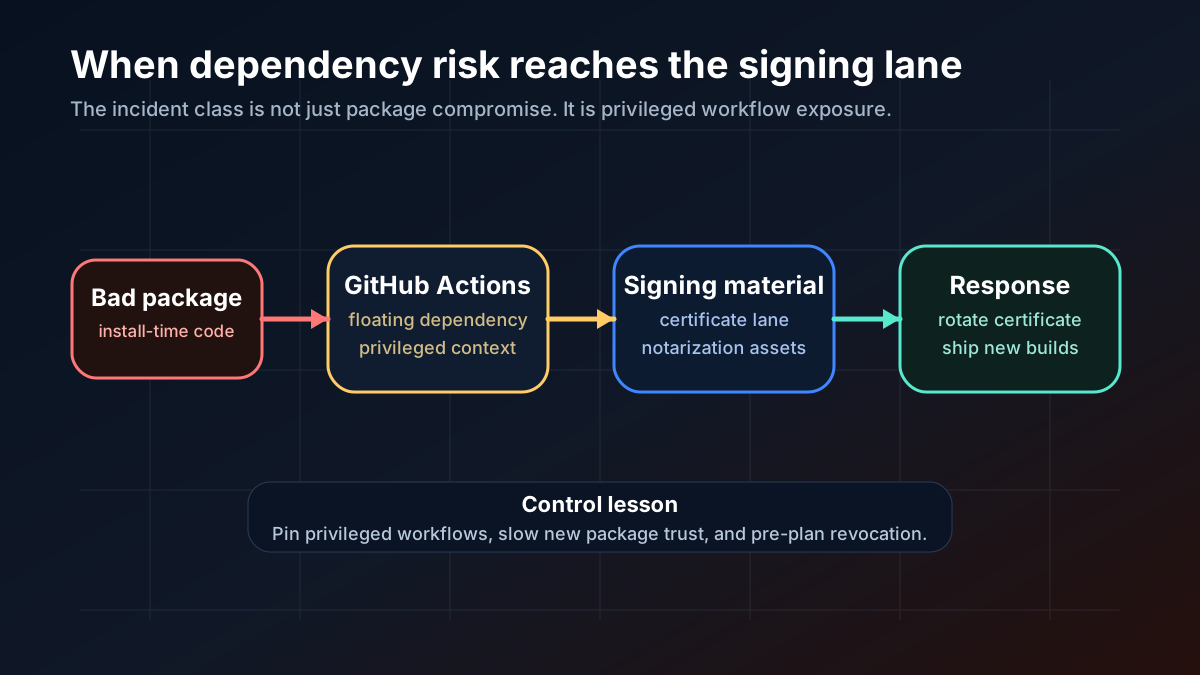
On April 10, 2026, OpenAI said a GitHub Actions workflow used in its macOS app-signing process had downloaded and executed axios version 1.14.1, one of the malicious packages published during the broader Axios npm compromise on March 31, 2026. OpenAI said the affected workflow had access to a certificate and notarization material used for signing ChatGPT Desktop, Codex App, Codex CLI, and Atlas for macOS. OpenAI also said it found no evidence that user data was accessed, its systems or intellectual property were compromised, or its software was altered. (OpenAI)
That distinction matters because this is not a story about OpenAI shipping malware.
It is a story about how thin the margin is between a routine CI convenience and a release-integrity problem.
What happened
There are two separate events to keep straight.
1. Axios itself was compromised on March 31, 2026
Microsoft said on April 1, 2026 that the malicious Axios releases were 1.14.1 and 0.30.4, and that both versions added a fake dependency, plain-crypto-js@4.2.1, which executed automatically during installation and pulled a second-stage RAT from attacker-controlled infrastructure. Microsoft attributed the Axios compromise to Sapphire Sleet, a North Korean state actor. Microsoft also said the malicious workflow targeted Windows, macOS, and Linux systems, including developer machines and CI/CD environments. (Microsoft Security Blog, axios issue #10604)
So the upstream event was already serious on its own.
2. OpenAI later disclosed that one of its macOS signing workflows touched the bad package
OpenAI said the GitHub Actions workflow involved in the macOS signing process downloaded and executed axios 1.14.1 on March 31, 2026 (UTC). That workflow had access to code-signing certificate and notarization material for its Mac apps. OpenAI said its investigation concluded the signing certificate was likely not successfully exfiltrated, citing the timing of payload execution, how the certificate was injected into the job, the sequence of the job itself, and other mitigating factors. But OpenAI still said it was treating the certificate as compromised, rotating it, and revoking it. (OpenAI)
That response is the real signal.
If signing material might have been exposed, the safe assumption is not “probably fine.” The safe assumption is “rotate first, explain second.”
What did not happen
This is where a lot of the social posts around the incident got sloppy.
OpenAI explicitly said:
- it found no evidence that OpenAI user data was accessed
- it found no evidence its systems or intellectual property were compromised
- it found no evidence its software was altered
- it found no evidence that malware had been signed as OpenAI software
- passwords and OpenAI API keys were not affected
Those are OpenAI’s own claims, not an independent third-party attestation. But they are also the only direct claims OpenAI has made publicly about its internal blast radius, and they are specific enough to matter. (OpenAI)
The more defensible framing is:
OpenAI disclosed a meaningful exposure in a sensitive release workflow, but it did not disclose evidence of an actual downstream compromise of users or signed OpenAI apps.
That is still a big story because code-signing systems sit close to the trust root of desktop software.
Why this matters more than a one-off app update
The practical lesson is not “always update your OpenAI app,” although that is true for affected Mac users.
The practical lesson is that supply-chain attacks now hit the places that certify software trust, not just the places that build features.
If a malicious actor ever gets usable signing material, the problem is not merely that a build job was touched. The problem is that they may be able to make their own software look like yours.
OpenAI said exactly that in its FAQ: if the certificate had been successfully compromised, an attacker could have used it to sign their own code so it appeared to come from OpenAI. OpenAI said it worked with Apple to block new notarization using the old certificate and planned full revocation on May 8, 2026, while giving users time to update to newly signed builds. (OpenAI)
That is why this is a release-engineering story, not just a vendor incident note.
The most useful technical detail is the root cause OpenAI named
OpenAI did something useful here: it named the class of mistake.
The company said the root cause was a misconfiguration in the GitHub Actions workflow. Specifically, it said the action used a floating tag instead of a specific commit hash and did not have a configured minimumReleaseAge for new packages. (OpenAI)
That is unusually actionable disclosure.
It means the security failure was not some exotic signing-system break. It was a familiar CI hygiene problem:
- a mutable dependency reference
- fast package resolution
- privileged workflow context
That combination shows up everywhere.
And Microsoft’s Axios write-up makes the broader ecosystem problem clearer. The company said the malicious Axios versions relied on an install-time dependency that executed through post-install with no user interaction required, and it recommended exact version pinning, forced overrides for transitive dependencies, restricted auto-upgrades, credential rotation, and broader review of CI logs. (Microsoft Security Blog)
So the real lesson is not “OpenAI got unlucky.”
The real lesson is that modern release pipelines still give small package-resolution decisions far too much leverage.
Who is affected
The direct operational impact is narrow:
- macOS users of ChatGPT Desktop, Codex App, Codex CLI, and Atlas need updated builds signed with the new certificate
- older versions signed with the previous certificate will stop receiving updates or support after May 8, 2026, and OpenAI said they may no longer function
OpenAI said the earliest versions signed with the updated certificate are:
- ChatGPT Desktop:
1.2026.051 - Codex App:
26.406.40811 - Codex CLI:
0.119.0 - Atlas:
1.2026.84.2
OpenAI also said the issue does not affect iOS, Android, Linux, Windows, or the web versions of its software. (OpenAI)
The broader audience affected is release engineers, security teams, and maintainers running GitHub Actions or similar CI for desktop distribution.
If you sign desktop apps, package CLIs, or ship auto-update clients, this incident is closer to your world than it may look.
What builders should change next
Three conclusions look justified from the public facts.
1. Signing workflows should be treated as a separate security tier
A lot of teams talk about “the CI pipeline” as one thing.
That is lazy architecture.
The pipeline that runs tests is not the same as the pipeline that touches code-signing or notarization material. Once those secrets are in scope, the workflow should be treated more like a production trust boundary than a normal automation job.
2. Mutable references in privileged workflows are harder to defend
OpenAI explicitly called out the use of a floating tag. That means this was not just a package compromise story. It was also a reminder that reproducibility and immutability are security controls, not just build-system preferences.
Microsoft’s guidance pushes the same direction from the dependency side: exact version pinning, overrides, reduced auto-upgrade behavior, and closer review of package changes in CI. (Microsoft Security Blog)
3. Revocation planning matters as much as prevention
OpenAI’s response was operational, not rhetorical:
- rotate the certificate
- publish new builds
- coordinate with Apple
- review notarization history
- give users a finite update window
That is what a serious response looks like when your trust root may have been touched.
The same pattern showed up in another recent AI-adjacent package incident: LiteLLM’s PyPI Compromise Is a Worst-Case Supply-Chain Incident for AI Teams. Different package ecosystem, same lesson: if your toolchain can silently land on privileged developer or CI environments, your blast radius is larger than your app surface.
What changes next
The obvious next move is not more performative “secure by design” language.
It is more boring and more important:
- stricter commit-pinned actions in privileged workflows
- slower trust on freshly published packages
- narrower credential exposure windows in CI jobs
- clearer separation between build, test, and signing stages
- preplanned revocation and customer-update playbooks
OpenAI’s disclosure will probably get remembered as a Mac app update notice.
That is too shallow.
The better takeaway is that desktop trust chains are now squarely inside the software supply-chain fight, and teams that ship developer tools or AI apps are not special exceptions. They are prime targets.
That also fits the broader AI security direction we have already been tracking. Anthropic Project Glasswing Is a Warning Shot for AI Security Teams argued that stronger models raise the pressure on operational security, not just product safety. This OpenAI incident is a more mundane but equally important version of the same rule: the real failures often happen in the workflows around the model, not in the model itself.
Bottom line
On April 10, 2026, OpenAI said a malicious Axios release had touched a GitHub Actions workflow used in its macOS signing process.
OpenAI did not say users were breached, products were tampered with, or malware had been signed as OpenAI software. It did say that code-signing and notarization material were exposed to a workflow that executed the malicious package, and it responded by rotating the certificate, shipping new Mac builds, and setting a May 8, 2026 cutoff for older versions.
The builder takeaway is straightforward:
if a compromised package can reach your signing lane, you do not have a dependency problem anymore. You have a trust-distribution problem.
SEO FAQ
Did OpenAI say user data was compromised in the Axios incident?
No. OpenAI said it found no evidence that user data was accessed, that its systems or intellectual property were compromised, or that its software was altered. The issue was still serious because a macOS app-signing workflow executed a malicious Axios package.
Why did OpenAI ask macOS users to update their apps?
OpenAI rotated and revoked signing material connected to its macOS app-signing process. Updating to the newer macOS builds makes sure users are running apps signed with the updated certificate instead of older builds tied to the previous certificate.
What is the release-engineering lesson from the OpenAI Axios incident?
The lesson is to isolate signing workflows from normal build and test jobs, pin privileged automation to immutable references, slow trust in newly published packages, and keep a certificate revocation plan ready before an incident happens.
Does this article explain how the Axios malware worked?
No. This article keeps the focus on defensive release engineering and supply-chain controls. It does not provide exploitation steps, payload details, or instructions for abusing package install hooks.
Sources