TL;DR
The obvious version of this story is that Novo Nordisk partnered with OpenAI to move faster in drug discovery.
That is true, but it is too narrow.
The more important version is that a major pharmaceutical company is now openly treating frontier AI as an operating layer across research, manufacturing, and commercial execution at the same time.
That is the part builders should pay attention to.
On April 14, 2026, Novo Nordisk announced a strategic partnership with OpenAI that will apply OpenAI’s technology across the company, from drug discovery to manufacturing to commercial operations. Novo said pilots will begin in research and development, manufacturing, and commercial teams, with broader integration planned by the end of 2026. The company also said the partnership includes strict data protection, governance, and human oversight. (Novo Nordisk, Reuters via Yahoo Finance)
That scope matters more than the announcement headline.
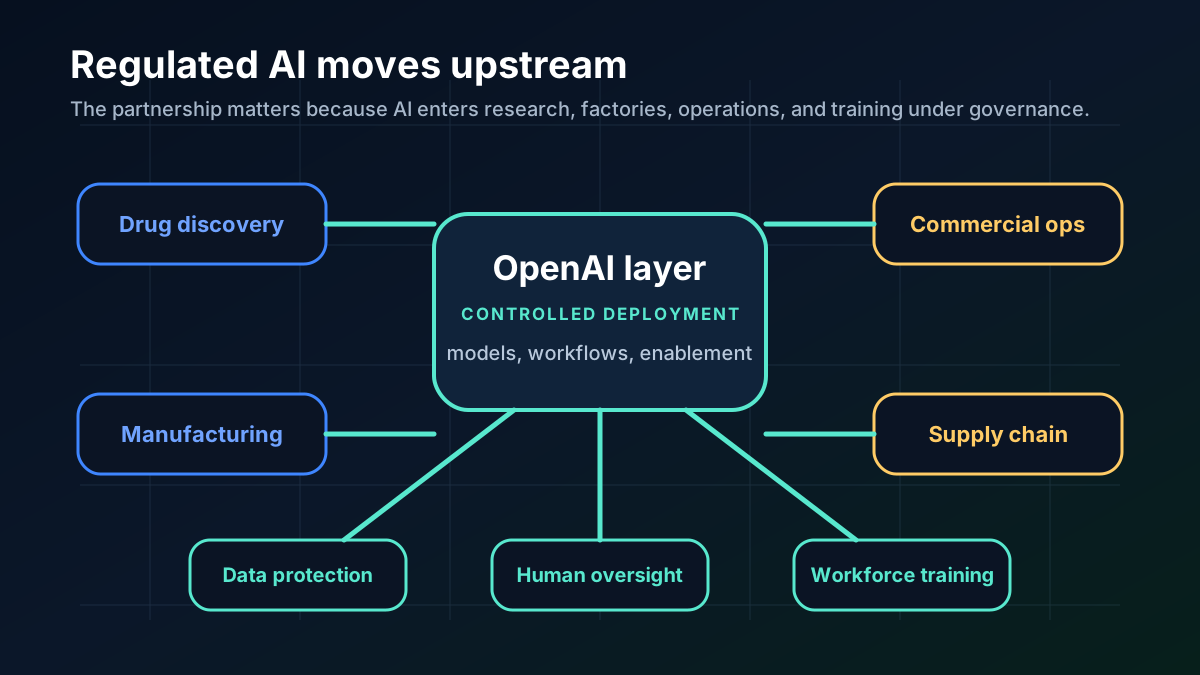
This is not a lab demo. It is a signal that AI adoption in regulated industries is moving further upstream into the workflows that decide what gets researched, how factories run, and how companies coordinate globally.
What happened on April 14, 2026
Novo Nordisk’s own announcement is unusually broad for a first-wave enterprise AI partnership.
The company said OpenAI’s systems will be used to:
- analyze complex datasets
- identify promising drug candidates
- reduce the time required to move from research to patient delivery
- improve efficiency across manufacturing, supply chains, distribution, and corporate operations
Reuters added a few useful operational details. CEO Mike Doustdar said the goal is not to replace scientists, but to “supercharge” them. Reuters also reported that OpenAI will help train Novo’s global workforce, increase AI literacy, and raise productivity across departments. (Reuters via Yahoo Finance)
There are two reasons that framing matters.
First, Novo is not presenting AI as a narrow research assistant. It is presenting AI as a company-wide productivity and decision layer.
Second, the company is explicitly pairing that expansion with governance language from day one. In pharma, that is not optional public-relations padding. It is table stakes.
Why this matters more than another enterprise AI rollout
Many enterprise AI deals still live in the safe zone:
- summarization
- internal search
- support copilots
- office productivity
This one does not.
Novo is pushing OpenAI into functions that sit much closer to regulated value creation:
- scientific discovery
- clinical and development support workflows
- manufacturing and supply planning
- commercial execution in a tightly scrutinized healthcare market
That changes the significance of the deal.
The real story is not that OpenAI won another enterprise logo. It is that regulated companies are becoming more willing to connect frontier models to operational systems that matter before the final customer-facing outcome exists.
That is a bigger trust threshold.
Novo’s timing is not random
Reuters’ reporting gives the business context that the press release softens.
Novo Nordisk is trying to regain momentum in an obesity-drug market where Eli Lilly has been gaining ground. Reuters noted that Lilly won U.S. approval for its weight-loss pill earlier in April 2026, while Novo is looking for ways to accelerate everything from discovery to production planning. Reuters also reported that Novo had already announced a major restructuring after Mike Doustdar took over as CEO in 2025. (Reuters via Yahoo Finance)
That matters because it makes the partnership easier to interpret.
This is not just “pharma gets interested in AI.” It is a competitive response from a company under pressure to move faster across multiple layers at once:
- find better candidates sooner
- move programs through development more efficiently
- run manufacturing and supply with less drag
- avoid adding headcount at the old rate
In other words, the AI bet is not only about science. It is also about organizational speed.
The OpenAI angle is bigger than healthcare
From OpenAI’s perspective, this is another sign that the company is moving deeper into vertical operating environments, not just general enterprise productivity.
We already argued in OpenAI Says Enterprise Is 40% of Revenue. The Real Story Is Platform Control. that OpenAI is trying to own more of the enterprise stack, from model access to runtime to end-user surface.
The Novo partnership strengthens that case.
Why?
Because pharma is one of the harder verticals to win credibly. It is not enough to say the model writes well or summarizes meetings quickly. The buyer cares about:
- governance
- auditability
- human review boundaries
- data handling
- domain-specific workflow value
When OpenAI lands a deal that spans discovery, manufacturing, and commercial operations inside a global drugmaker, it is effectively making a claim that its technology can be trusted inside more regulated environments than pure software teams.
That does not mean the trust question is solved. It does mean the commercial ambition is getting clearer.
Novo was already building an AI stack before OpenAI
This point is important because people will misread the announcement if they treat OpenAI like Novo’s first serious AI move.
It is not.
In June 2025, NVIDIA said it was partnering with Novo Nordisk and Denmark’s AI ecosystem around Gefion, the Danish sovereign AI supercomputer, to support drug-discovery efforts, custom models, and agentic AI workflows for early research and clinical development. NVIDIA said Novo planned to use BioNeMo, NeMo, NIM, and simulation tooling to run drug-discovery and scientific AI work at scale. (NVIDIA)
That means the April 14 OpenAI deal should be read as an expansion of Novo’s AI stack, not a first step into AI.
The likely pattern looks more like this:
- specialized infrastructure and scientific-model work through existing AI programs
- frontier model and workflow integration through OpenAI
- broader workforce adoption and operational rollout through internal tooling and training
For builders, that is the more realistic enterprise pattern anyway. Big organizations do not replace their whole AI stack with one vendor. They layer capabilities.
What this changes for builders
If you build AI products, internal platforms, or workflow tooling, there are three practical takeaways here.
1. The real enterprise prize is upstream workflow insertion
A lot of AI vendors still talk like the goal is to attach a model to the edge of work.
But the higher-value move is to get inside the process before decisions harden.
In Novo’s case, that means AI is being aimed at:
- candidate identification
- development acceleration
- manufacturing efficiency
- supply and commercial coordination
That is where switching costs get stronger, because the AI system stops being a convenience feature and starts becoming part of how the company operates.
2. Governance language is now product surface
Novo’s announcement explicitly mentions data protection, governance, and human oversight. That is not filler.
In regulated industries, those promises are part of the product. If your AI tooling cannot explain how humans stay in the loop, how data is handled, and where decisions are reviewed, you are not really competing for these deployments.
This is the same broader lesson we have been making in AI Coding Agents Need Guardrails, Not More Autonomy. The more consequential the workflow, the less defensible the pure-autonomy pitch becomes.
3. Workforce enablement is becoming part of AI platform sales
Reuters reported that OpenAI will help Novo improve AI literacy and train its workforce globally. That is worth noticing.
The AI vendor is no longer selling only a model or an API. It is also selling rollout capacity:
- training
- operating guidance
- adoption support
- change management
That is a sign the enterprise market is maturing. The deal is not done when access is provisioned. It is done when the organization changes behavior.
What does not follow from this news
There are also a few bad conclusions to avoid.
This does not mean AI has solved drug discovery
Reuters was careful here, and that caution is correct. Drugmakers are increasingly using AI to speed tedious parts of development and regulatory work, but executives still say the harder task of discovering major new molecules has not been fully transformed yet. So no, this announcement is not proof that OpenAI is about to invent Novo’s next blockbuster treatment by itself. (Reuters via Yahoo Finance)
This does not mean scientists are being replaced tomorrow
Novo’s CEO said the aim is not replacing scientists. That is still a company statement, not a binding guarantee about every future staffing decision. But based on the public reporting, the immediate intent looks more like leverage and throughput than direct role elimination.
This does not mean one vendor owns the whole stack
Novo already had AI initiatives with other technology partners. The OpenAI partnership broadens the stack. It does not erase the rest of it.
That is why the better interpretation is “OpenAI won an important layer” rather than “OpenAI became the whole platform.”
What changes next
Three things are worth watching after April 14, 2026.
1. Whether the pilots stay broad or get narrowed by governance reality
It is easy to announce pilots across R&D, manufacturing, and commercial operations. It is harder to keep all three moving once compliance, validation, and organizational politics start pushing back.
2. Whether OpenAI can turn more regulated-industry wins into a repeatable motion
If this deal becomes a pattern across pharma, healthcare, finance, or industrial companies, it would strengthen the case that OpenAI is becoming a serious vertical-enterprise platform vendor rather than mainly a horizontal AI brand.
3. Whether competitors answer with more domain-specific stacks
This kind of announcement creates pressure on rivals to show:
- stronger compliance posture
- better domain tooling
- more workflow control
- clearer integration into regulated operations
That is where the next phase of enterprise AI competition is likely to move.
Bottom line
Novo Nordisk’s April 14, 2026 partnership with OpenAI is easy to frame as a drug-discovery headline.
That is only part of the story.
The more important point is that Novo wants to use OpenAI across research, manufacturing, and commercial operations, while explicitly packaging the rollout with governance, oversight, and workforce training.
That combination tells you where enterprise AI is heading:
away from assistant experiments at the edge of work, and toward controlled insertion into the workflows that actually run large regulated companies.
For builders, that is the signal to track. The next durable AI winners will not just have strong models. They will have a credible answer for how those models fit inside consequential systems without pretending governance is somebody else’s problem.
SEO FAQ
What is Novo Nordisk using OpenAI for?
Novo Nordisk said on April 14, 2026 that it will use OpenAI across drug discovery, manufacturing, and commercial operations. The partnership goes beyond a simple API integration — it signals a pharmaceutical company embedding AI across its entire value chain, not just in R&D.
Does this deal mean AI will discover new drugs faster?
Not necessarily. AI can accelerate target identification, molecule screening, and literature review, but drug development still requires clinical trials, regulatory approval, and years of validation. The deal may speed up early-stage research and manufacturing optimization, but it does not eliminate the fundamental timeline constraints of drug development.
Is Novo Nordisk the first pharma company to partner with OpenAI?
No. Multiple pharmaceutical companies have partnered with AI labs. What makes this deal notable is its breadth — covering discovery, manufacturing, and commercial operations — rather than being limited to a single use case like molecular design.
What does this deal mean for AI in healthcare?
The Novo-OpenAI partnership is a signal that large pharmaceutical companies are moving from experimental AI pilots to operational integration. If the deal produces measurable improvements in drug discovery speed, manufacturing efficiency, or commercial operations, it will pressure other pharma companies to adopt similar strategies.
Sources