TL;DR
NVIDIA GTC 2026 should be read less as a single hardware event and more as a platform-control event.
The useful builder takeaway is not “NVIDIA announced more AI things.” It is that NVIDIA is continuing to connect compute, networking, inference services, robotics tooling, virtual-world simulation, and sovereign AI into one operational stack. That stack can be powerful when you are all-in. It can also create real dependency risk if your own product cannot tolerate a single vendor shaping the upgrade path.
If you are planning AI infrastructure for 2026, the decision is not simply whether NVIDIA is ahead. The decision is where you want to optimize:
- maximum performance inside the NVIDIA ecosystem
- regional deployment control for sovereignty and compliance
- robotics and physical-AI tooling
- inference cost and model-serving operations
- portability across non-NVIDIA accelerators and cloud providers
Those choices affect architecture more than a keynote recap headline.
What mattered at GTC 2026
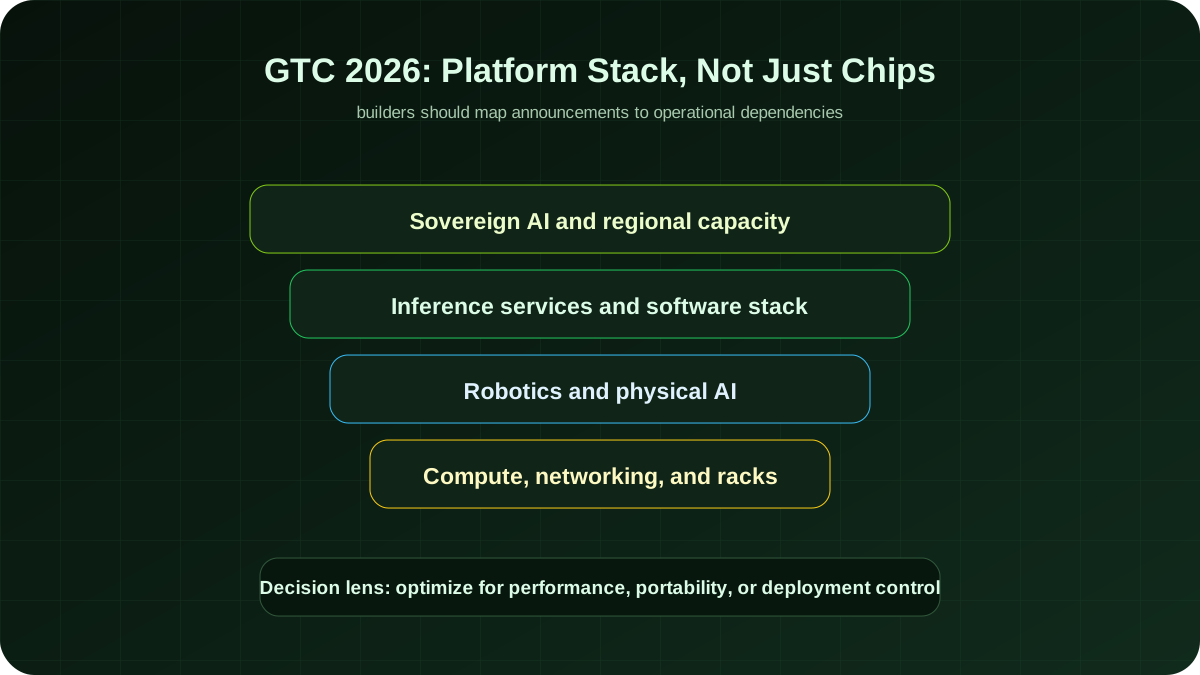
NVIDIA’s own GTC 2026 coverage emphasized a wide platform story: AI factories, sovereign AI, simulation and physical AI, inference services, and industry-specific deployment. The interesting point is how closely those themes now connect.
For builders, the stack breaks into four practical layers.
1. Compute and networking
NVIDIA still anchors its pitch in accelerated computing, racks, networking, and data-center-scale deployment. That matters because modern AI performance is no longer just a GPU benchmark. It depends on memory, interconnect, rack design, software libraries, and whether the operator can feed the hardware efficiently.
The planning question is direct: can your workload justify staying close to the full NVIDIA stack, or do you need enough abstraction to switch accelerators later?
2. Inference and services
NVIDIA NIM and related software services matter because inference operations are becoming a product surface. Builders are not only choosing chips. They are choosing model-serving patterns, observability paths, deployment packaging, and update cadence.
That makes this similar to the broader gateway and model-routing decisions we have covered in LiteLLM vs OpenRouter vs Vercel AI Gateway. The hardware layer and serving layer are increasingly bundled.
3. Physical AI and robotics
NVIDIA’s physical-AI and virtual-world messaging is relevant because robotics needs more than a model checkpoint. It needs simulation, data generation, testing, control loops, and deployment tooling.
For most software teams, the immediate action is not “build a robot.” The action is to watch whether simulation-trained agents and robotics foundation models become normal parts of industrial automation procurement.
4. Sovereign AI
Sovereign AI keeps showing up because governments and regulated industries want local infrastructure, local data handling, and control over critical workloads. This is not only a policy story. It changes buying behavior for cloud, data centers, model providers, and hardware vendors.
That connects directly to the infrastructure pattern in Mistral Raised $830M in Debt for a Paris AI Data Center and the supply-chain pattern in China’s Domestic AI Chips Hit 41% Share.
Builder checklist
Use GTC 2026 as a planning prompt, not as a reason to rewrite your stack overnight.
Before making an infrastructure decision, answer these:
- Performance dependency: which workloads truly need NVIDIA-specific optimization?
- Portability boundary: where can you isolate CUDA, serving runtimes, observability, and deployment assumptions?
- Regional requirement: which customers require local data processing or local compute contracts?
- Procurement risk: what happens if a preferred GPU class is delayed, repriced, or unavailable in one region?
- Upgrade cadence: can your team absorb NVIDIA’s platform upgrades without destabilizing production?
The right answer can still be NVIDIA-first. The mistake is pretending that NVIDIA-first is the same thing as vendor-neutral.
What not to overread
Do not overread keynote framing as guaranteed product availability, exact performance, or immediate procurement reality. Conference announcements often compress several timelines into one narrative.
For AdSense-safe and reader-useful analysis, the practical boundary is this: treat GTC as a signal about platform direction, then verify exact products, regional availability, pricing, and support terms before making technical or procurement commitments.
This article is not investment advice, procurement advice, or a prediction of NVIDIA stock performance. It is a builder-oriented architecture read.
SEO FAQ
What was the main theme of NVIDIA GTC 2026?
The main builder-facing theme was platform integration: accelerated compute, inference software, physical AI, simulation, and sovereign AI are being presented as one connected infrastructure stack.
Should developers build only for NVIDIA after GTC 2026?
Not automatically. NVIDIA-first optimization can be rational for performance and ecosystem reasons, but teams should still document where their stack depends on CUDA, NVIDIA-specific services, deployment tooling, and observability paths.
Why does sovereign AI matter to builders?
Sovereign AI matters because it changes where workloads run, how data is handled, and what governments or regulated buyers require from cloud and model providers. It can make regional compute availability a product requirement rather than a preference.
Is this recap investment advice?
No. This is technology and infrastructure analysis for builders. Product, procurement, legal, and investment decisions require current official documentation and professional review.
Sources