
TL;DR
Europe’s AI race is starting to look less like “startup fundraising” and more like infrastructure finance.
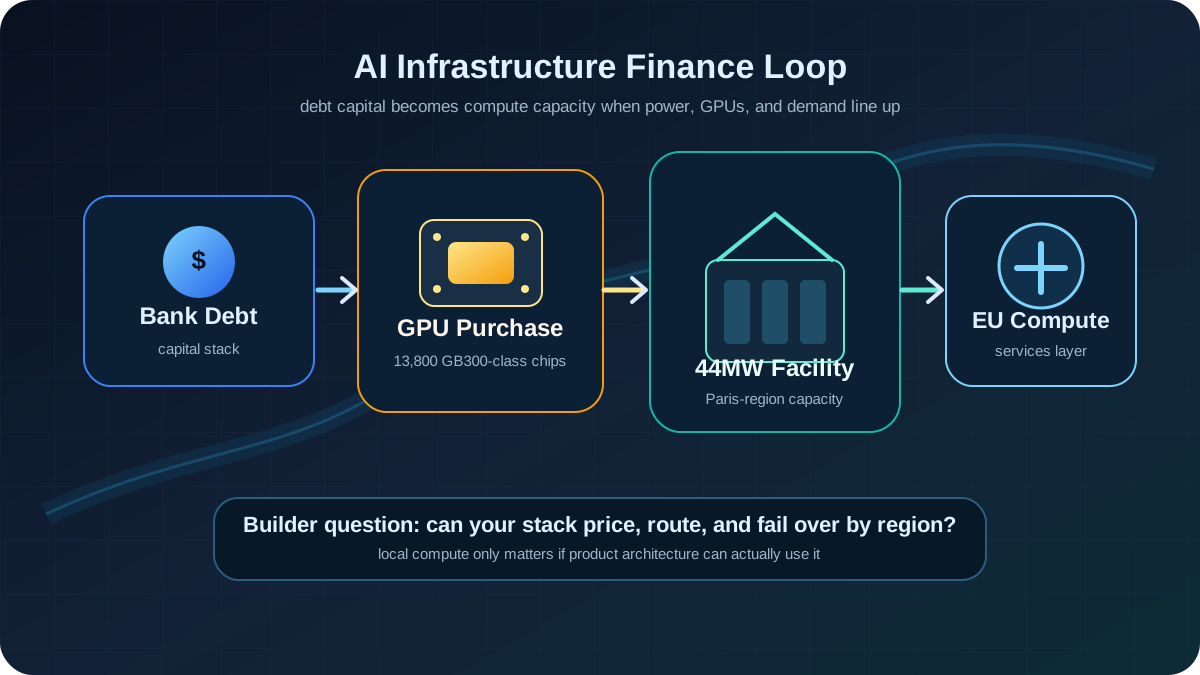
On March 30, 2026, French AI company Mistral said it raised about $830 million in debt to fund a new data center near Paris and to buy 13,800 Nvidia chips. Reuters reported the site in Bruyères-le-Châtel is expected to become operational in Q2 2026. Euronews/AP reported the facility is sized for 44MW and “more than 13,000” Nvidia chips. A financing note published the same day by Gide (Mistral’s counsel on the deal) says the funding will contribute to acquiring 13,800 NVIDIA GB300 GPUs. That is a very specific signal: Europe is not just talking about “sovereign AI.” It is financing it.
This story matters for builders because it changes what you should expect from the European AI market over the next 12–18 months: more locally anchored compute, more supply competition for top-end accelerators, and more pressure on cloud and API pricing.
What actually happened (in plain terms)
Mistral secured a debt package totaling roughly $830 million to stand up and operate a Paris-region data center and to fund a large GPU purchase tied to that facility.
Gide describes the financing as two tranches (approximately $720 million and €94 million) provided by a syndicate of banks that includes BNP Paribas, Bpifrance, Crédit Agricole CIB, HSBC, La Banque Postale, MUFG, and Natixis.
Separately, Euronews/AP reported the buildout is sized to reach 44MW of power capacity, while Reuters reported an operational target of the second quarter of 2026.
Why the debt angle is the real headline
Plenty of AI companies raise equity. What is different here is structured debt against an AI infrastructure plan.
Debt markets are conservative by design. They care about cash-flow visibility, collateral, and execution risk. So when a model company starts financing compute like a data center operator, it suggests three things:
- Compute is becoming a balance-sheet product. The market is pricing “model capability” less as a demo and more as a supply chain: power, racks, cooling, and long-term utilization.
- Big GPU clusters are becoming financeable assets. If lenders get comfortable underwriting this, expect more European AI players to pursue similar capital stacks instead of relying purely on equity.
- Europe is trying to close the infrastructure gap, not just the model gap. The fastest way to lose an AI platform war is to depend entirely on someone else’s compute layer.
Who is affected (and how)
Builders shipping in Europe
If you are selling AI features to EU customers, this is a signal that data residency + latency + procurement will matter more.
In the near term, you should watch for:
- more EU-based capacity options (and potentially new pricing tiers)
- improved throughput for EU-region workloads as supply expands
- new compliance-flavored offerings that bundle “EU compute” with auditability and contracts
Cloud incumbents
The Reuters framing is blunt: the move is part of Europe’s push to compete with U.S. hyperscalers in cloud and AI services.
This does not mean Mistral will outscale the hyperscalers. It does mean hyperscalers will face more credible local competition in enterprise deals where sovereignty is the deciding factor.
Nvidia’s supply chain (and everyone waiting for top-end accelerators)
A 13,800-GPU order is not “nice to have.” It is a supply commitment.
If you are a startup trying to secure similar-class accelerators for training or high-throughput inference, the practical takeaway is simple: availability is shaped by who can finance and commit at infrastructure scale.
What changes next (the builder checklist)
If you are building with frontier models in 2026, the best posture is to assume the market is splitting into two layers:
- model layer: who has the best capabilities, safety profile, and developer ergonomics
- infrastructure layer: who has the most reliable compute footprint where customers actually need it
Here is the tactical checklist:
- Design for multi-provider inference. Avoid hard-coding a single model API into your architecture unless switching costs are part of your moat.
- Treat “region” as a product constraint. If you sell to regulated buyers, EU-region inference is often a requirement, not a preference.
- Benchmark cost and latency by geography. Your “best model” choice can flip once you price in EU-region performance and egress.
- Watch contract terms, not just tokens. The real differentiator in enterprise AI is increasingly uptime, indemnities, audit hooks, and data handling.
If you want a policy lens on the same infrastructure story, see: The White House Wants One Federal AI Rulebook. Here’s What That Means.. If you want the hardware geopolitics angle, see: Supermicro Smuggling Claims Show How Messy AI Chip Export Controls Have Become..
Infrastructure finance checklist
Do not read this as a normal startup funding headline. For builders, the useful question is whether the financed compute footprint changes deployment choices. Track these signals before changing your architecture:
- Regional availability: whether EU-region inference capacity is actually bookable by developers and enterprises, not just announced.
- Latency and throughput: whether local compute materially improves response time for European users compared with existing hyperscaler regions.
- Contract shape: whether Mistral packages the facility as reserved capacity, managed API capacity, enterprise cloud, or internal training infrastructure.
- Data handling: whether offerings tied to the facility include residency, audit, retention, and privacy commitments that regulated buyers can contract against.
- Utilization risk: whether demand is strong enough to keep a debt-financed GPU cluster productive after the initial launch window.
That last point matters because debt turns compute into a recurring obligation. A large GPU cluster can be strategic leverage when utilization is high. It can become financial drag if model demand, pricing, or power economics move the wrong way.
Reader boundary
This article is infrastructure and product strategy analysis, not investment, credit, procurement, tax, or legal advice.
Use it to frame technical planning questions:
- can your inference layer route by geography?
- can your contracts support EU-region data requirements?
- can your cost model compare API pricing against reserved regional capacity?
- can your fallback path survive a regional GPU shortage?
- can you avoid hard-coding one provider when infrastructure financing changes the capacity map?
Do not use it to predict Mistral’s valuation, Nvidia demand, bank-credit risk, or cloud-stock performance. Those are financial claims that need current market data and professional review.
SEO FAQ
How much debt did Mistral raise for the Paris data center?
Mistral announced roughly $830 million in debt financing. Gide described the financing as approximately $720 million plus EUR 94 million, with proceeds tied to operating a data center in Bruyeres-le-Chatel and acquiring 13,800 NVIDIA GB300 GPUs.
What is the planned size of the Mistral data center near Paris?
Euronews/AP reported the facility is planned at 44MW and more than 13,000 Nvidia chips. Reuters reporting, mirrored by Investing.com and summarized by TechCrunch, said the site in Bruyeres-le-Chatel was expected to become operational in the second quarter of 2026.
Why does debt financing matter for AI infrastructure?
Debt financing matters because it treats compute capacity as an infrastructure asset rather than only a startup expense. Lenders care about utilization, collateral, execution risk, and cash-flow visibility, which makes the deal a signal about how AI data centers are being financed.
What should builders watch after this Mistral deal?
Builders should watch EU-region capacity availability, latency, pricing, data-residency terms, contract structure, and whether Mistral exposes the new capacity through APIs, enterprise cloud contracts, or mostly internal workloads.
Is this article investment advice?
No. This is technical and infrastructure analysis. It is not investment, financing, procurement, tax, or legal advice.
Sources