Every few weeks, an open-source AI project shows up with a pitch so large it sounds either important or unserious.
MiroFish is one of those projects.
On GitHub as of March 26, 2026, the project describes itself as a “simple and universal swarm intelligence engine” for predicting almost anything. That language is obviously ambitious. The more useful question is whether there is a real tool underneath the slogan.
There is, and that is why it is getting attention.
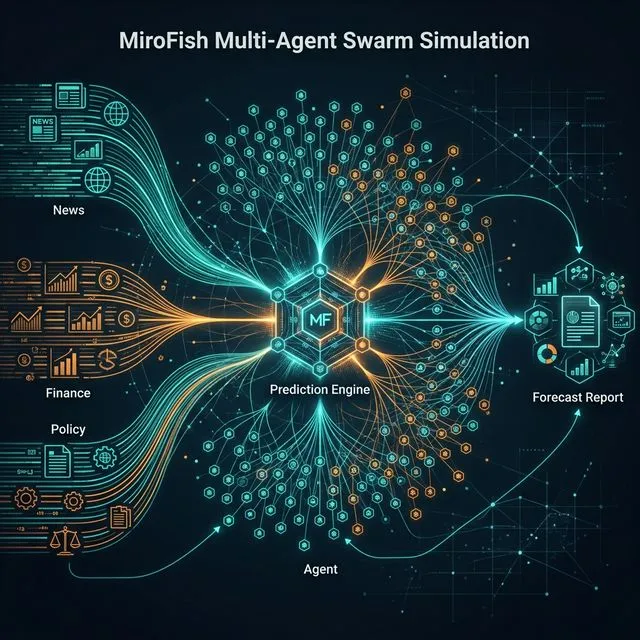
According to the project’s public repository, MiroFish is an open-source multi-agent simulation system designed to take seed material such as news, policy drafts, financial signals, or narrative text, turn that material into a structured digital environment, and then simulate interactions between large numbers of agents with memory, roles, and behavior logic. The output is supposed to be both a prediction report and an interactive simulated world you can inspect further.
That is a much more specific idea than “AI predicts the future.”
What MiroFish actually is
At a practical level, MiroFish looks like a simulation-heavy forecasting and scenario engine built on top of multi-agent orchestration.
The repository’s workflow describes five major stages:
- graph construction from real-world seed data
- environment setup with entities, relationships, and simulation parameters
- parallel multi-agent simulation
- report generation
- deeper interaction with the simulated world and its agents
The project also says its simulation engine is powered by OASIS from the CAMEL-AI ecosystem, and its stack mixes Python and Vue. The public repo also shows both a frontend and backend, a demo deployment, and a relatively active commit history.
That makes MiroFish more than a concept note.
It looks like a real open-source application, even if its biggest claims still deserve skepticism.
Why people are paying attention
The simplest reason is that MiroFish combines several themes that are already hot:
- multi-agent systems
- long-memory simulation
- GraphRAG-style world building
- forecasting and scenario planning
- “digital twin” language for social or market prediction
That package is easy to understand at a glance. It promises something bigger than chat and more strategic than a single assistant.
And unlike a lot of theoretical agent projects, MiroFish is presented as a usable product with:
- a public repo
- demo materials
- deployment instructions
- an opinionated workflow
As of March 26, 2026, the GitHub repo is also showing unusually high traction for a niche project, with tens of thousands of stars and thousands of forks. Even if star count is not proof of quality, it is proof that the idea has hit a nerve.
What problem it is trying to solve
Most AI tools today are still built around direct response:
- ask a question
- get an answer
- maybe call a tool
- maybe generate a report
MiroFish is trying to do something different.
It is treating prediction as a social simulation problem, not just an inference problem.
The core bet is that many real-world outcomes are shaped by interacting actors, memory, incentives, and feedback loops. If that is true, then a system that simulates those interactions may be more useful than a single model producing a one-shot forecast.
That is a serious idea.
It also happens to be one of the harder AI product categories to make credible.
Where MiroFish fits in the current AI tool landscape
The best way to understand MiroFish is not as a general-purpose chatbot competitor.
It fits better in a narrower category:
- forecasting labs
- policy scenario simulation
- public-opinion modeling
- market or financial narrative testing
- interactive “what if” environments
That makes it adjacent to agent frameworks, but not identical to them.
This is one reason it pairs naturally with the broader points we already made in AI Agents Are Everywhere, but Which Ones Are Genuinely Useful?. A useful agent system is usually not “general intelligence.” It is a tool with a bounded job, a coherent workflow, and outputs that can actually be evaluated.
MiroFish at least has that structure.
The strongest part of the project
The strongest part is that it has a concrete operating model.
A lot of multi-agent projects still feel like architecture diagrams waiting for a use case. MiroFish starts with a use case first:
- feed in seed material
- construct a simulated environment
- run agents inside that environment
- generate a report
- continue interrogating the simulated world
That makes it easier to assess as a product rather than just a research posture.
It also helps that the repo is open about the kinds of material it wants to ingest: news, policy, finance, and even fiction. That range sounds odd at first, but it reveals the underlying product idea clearly. MiroFish is not just trying to answer questions. It is trying to simulate evolving systems.
The biggest caveat
This category is extremely easy to oversell.
There is a huge difference between:
- generating plausible scenario branches
- surfacing useful strategic possibilities
- producing accurate real-world predictions
MiroFish’s own branding leans hard into “predict anything.” That should be treated as marketing language, not a demonstrated scientific result.
If you are evaluating it seriously, the right standard is not:
Can it predict the future?
The right standard is:
Does it generate useful, inspectable scenarios that improve decision-making compared with simpler alternatives?
That is a much tougher and more honest test.
This is the same general discipline issue behind Why AI Hallucinates. Once a system becomes good at producing plausible outputs, people start over-trusting confidence and under-testing grounding. Prediction engines are especially vulnerable to that trap.
Practical take
If you are a founder, analyst, researcher, or builder experimenting with multi-agent systems, MiroFish is worth paying attention to for three reasons:
- it packages simulation as a usable product instead of a vague framework
- it shows where open-source agent tooling is going beyond chat and task execution
- it pushes on a genuinely interesting question: whether agent societies are a better interface for forecasting than direct prompts
If you are evaluating it for production decision-making, the burden of proof should stay high.
Interesting tool does not mean trustworthy forecaster.
Still, as a signal, MiroFish matters. It shows that the AI tools market is widening beyond assistants, copilots, and coding agents into more speculative but potentially high-value categories like simulation and scenario modeling.
Final verdict
MiroFish is not important because it has solved prediction.
It is important because it packages multi-agent simulation, world modeling, and report generation into a form that people can actually try.
That is enough to make it notable.
The project may turn out to be overhyped. Most projects in this category are.
But the underlying direction is real:
AI tools are moving from answering questions to simulating systems.
MiroFish is one of the clearer open-source examples of that shift right now.
Sources