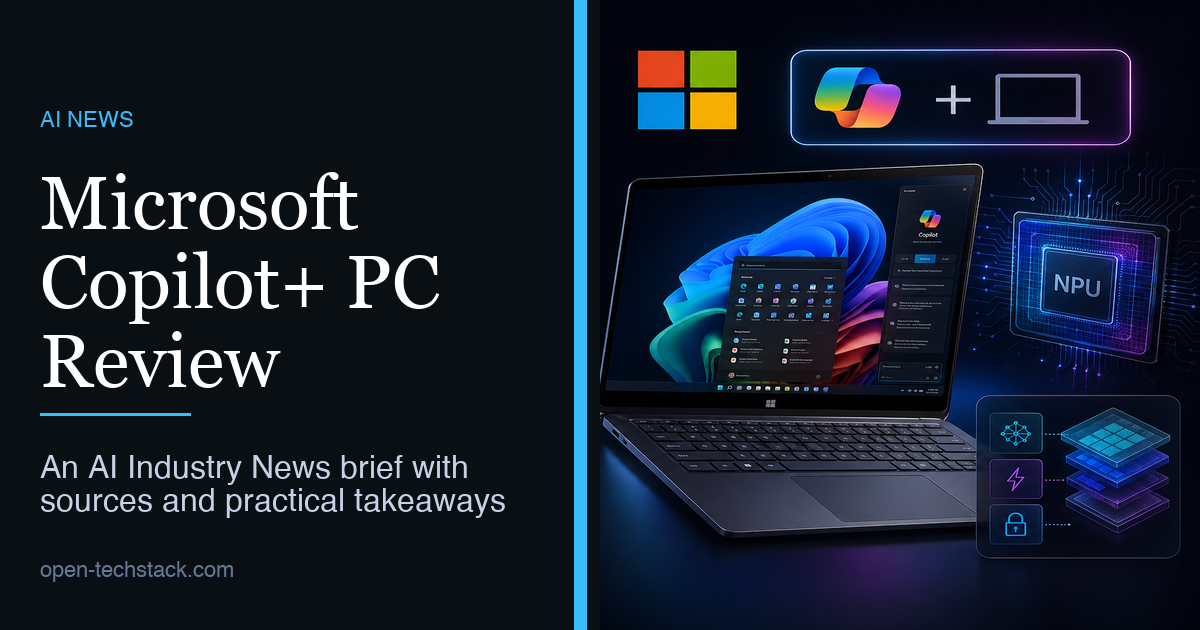
Microsoft Copilot+ PC Review deserves attention because it touches the practical trade-offs that matter to AI builders: capability, cost, deployability, and control. Instead of treating this as hype, this analysis focuses on whether the update improves day-to-day execution for teams shipping real workflows.
What happened
Based on the available sources, this update represents a meaningful shift in the AI tooling or model landscape rather than a minor feature increment. The change is relevant because it can alter how teams choose providers, how quickly they ship features, and how much operational risk they carry when workloads scale.
For operators and technical leads, the key first step is to separate announcement language from production reality. That means checking what was officially released, what remains in preview, what pricing and limits apply, and what integration work is required before value can be realized.
Why it matters now
Most AI stacks fail not because the model is weak, but because workflow reliability, observability, and governance are weak. A new platform or release only matters if it improves one or more of these dimensions with measurable impact.
For Open-TechStack readers, the highest-signal questions are:
- Does this reduce engineering effort for common tasks?
- Does it improve quality per dollar for real workloads?
- Does it preserve deployment flexibility and portability?
- Does it improve controls for security, compliance, and auditability?
If the answer is “yes” on at least two of those, the release is likely worth piloting.
Practical impact by team
Product and delivery
Teams can use this update to shorten iteration loops if integration is straightforward and model behavior is stable. The practical win is faster time-to-first-prototype and fewer blocked handoffs between product and engineering.
Engineering and platform
Platform teams should evaluate deployment complexity, fallback behavior, and observability hooks before rollout. A feature that looks strong in demos can still create outages if retries, rate limits, or model drift are not handled intentionally.
Governance and leadership
Leaders should evaluate risk concentration. If this release pushes your stack toward tighter vendor coupling, introduce fallback providers, clear runbooks, and an explicit rollback path from day one.
30-day evaluation plan
- Week 1 — Baseline: capture current latency, quality, and cost-per-task metrics.
- Week 2 — Pilot: run controlled A/B tests on 2–3 realistic workflows.
- Week 3 — Stress test: test failure modes (rate limits, malformed outputs, degraded retrieval).
- Week 4 — Decision: adopt, defer, or narrow-scope rollout based on measured outcomes.
A disciplined evaluation is better than immediate full adoption. The goal is not to be first to try a release; the goal is to improve reliability and output quality without increasing operational fragility.
Decision checklist
- Validate claims against official release docs and independent testing.
- Confirm pricing, quotas, and terms for your expected workload size.
- Verify data handling, logging, and retention behavior.
- Add monitoring for latency, error rate, and cost drift.
- Define fallback routing before broader rollout.
Implementation blueprint
A practical implementation blueprint is to keep rollout incremental. Start with one bounded workflow where output quality is easy to review, such as internal documentation drafting, support reply suggestions, or engineering triage summaries. Keep a human review gate in the loop until the workflow consistently meets your acceptance criteria.
Next, separate experimentation from production routing. Do not replace your existing critical path immediately. Instead, run shadow traffic or side-by-side evaluations where the new stack can be compared directly against your current baseline. This gives your team measurable evidence rather than intuition.
Finally, formalize rollback conditions before launch. If quality drops below target, latency spikes, or costs exceed budget thresholds, the system should route to a known-good fallback provider automatically. This approach keeps adoption fast without sacrificing operational safety.
What to measure in production
Track outcomes at the task level, not just model-level averages. The most useful KPIs are:
- Task completion rate: percent of requests resolved without manual rework.
- First-pass quality score: evaluator or reviewer score on initial outputs.
- Time-to-resolution: end-to-end duration for the workflow, not only model latency.
- Cost per completed task: token and infrastructure cost normalized by successful outcomes.
- Escalation rate: how often a workflow needs human takeover.
Teams that monitor these indicators can identify whether a release creates real leverage or just shifts effort to post-processing and review. A model that looks cheaper per token can still be more expensive if correction overhead increases.
When to defer adoption
Deferring adoption can be the right decision when documentation is incomplete, pricing policy is unstable, or reliability under load is unproven. If your use case is mission-critical and audit-heavy, wait until controls and observability are mature enough to satisfy your governance standards.
A second reason to defer is ecosystem immaturity. If core integrations, tooling libraries, or community-tested patterns are still sparse, early adoption may consume more engineering cycles than it saves. In that case, run a lightweight monthly reassessment and revisit once the ecosystem catches up.
Sources
- Microsoft Copilot Review: An Epic Assortment of AI Features | PCMag — Copilot’s robust, varied functionality, deep integrations with Windows and Microsoft apps, and bundled cloud storage make it a serious value among AI chatbots. …
- Customer Reviews: Microsoft Surface Laptop 13.8” 2K Touchscreen Snapdragon X Plus 2024 16GB Memory 256GB Storage (7th Ed) Copilot+ PC Platinum ZGJ-00001 - Best Buy — It is one of the best laptops I have used and does everything I need it to and then some. I use it a great deal for work and also for crafting, web browsing, and s
- My Year With a Copilot+ PC: Where’s the AI Revolution Microsoft Promised? | PCMag — This feature is nice to see, but I still don’t think it’s enough to warrant replacing your PC. Besides, a redesigned Settings app with better search functionality (Semant
- I used a Copilot+ PC for 2 months, and it’s game-changing — The introduction of Copilot+ PCs represents a significant evolution in this product line. The Surface Pro 11 is powered by Qualcomm’s Snapdragon X-series processor — a depart
- I’ve tried the new AI features of Copilot+ PCs and I’m (mostly) impressed - here’s why | Tom’s Guide — I saw the future of AI in Windows at Microsoft Build 2024, and it’s exciting. I’m talking specifically about the new features for Copilot+ PCs that Microsoft made a big s
Related posts