The latest AI arms-race story is not another model launch.
It is a factory claim so large that it makes most data-center announcements look small.
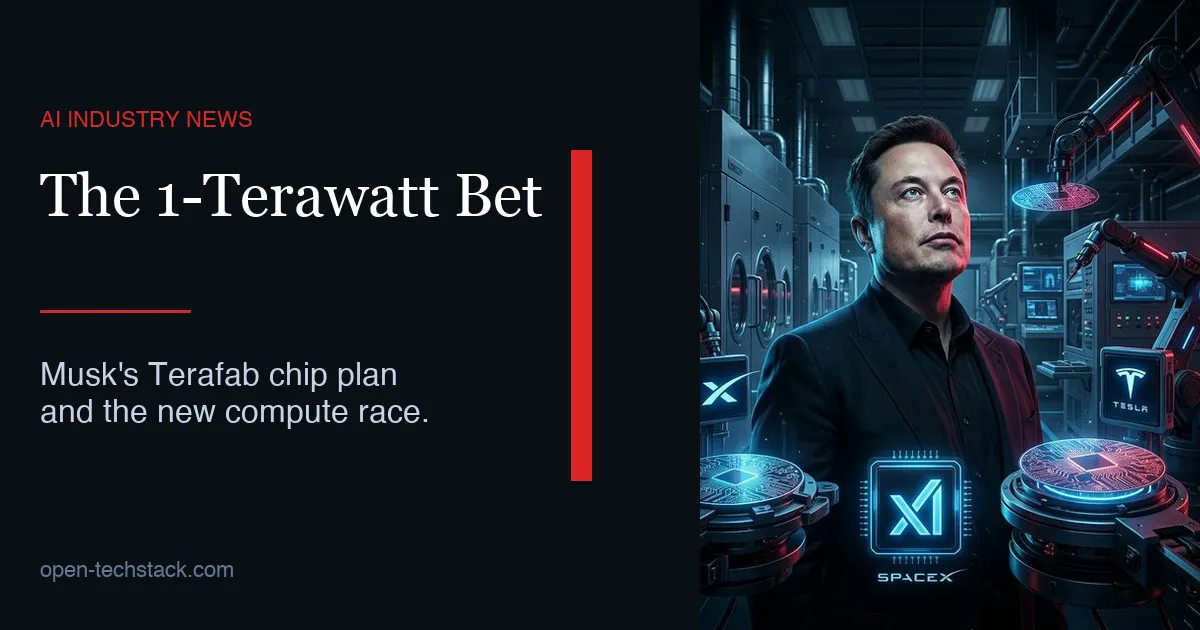
According to reporting from Axios and Tom’s Hardware on March 22, 2026, Elon Musk has formally introduced Terafab, a proposed chip-manufacturing project spanning Tesla, SpaceX, and xAI. Musk says the goal is to build a vertically integrated semiconductor operation in Austin that can eventually produce 1 terawatt of AI compute per year.
That number is the headline.
The more useful part is what it signals: the biggest AI players are no longer just competing on models, GPUs, and data centers. They are trying to control the entire supply chain of compute.
What Terafab is supposed to be
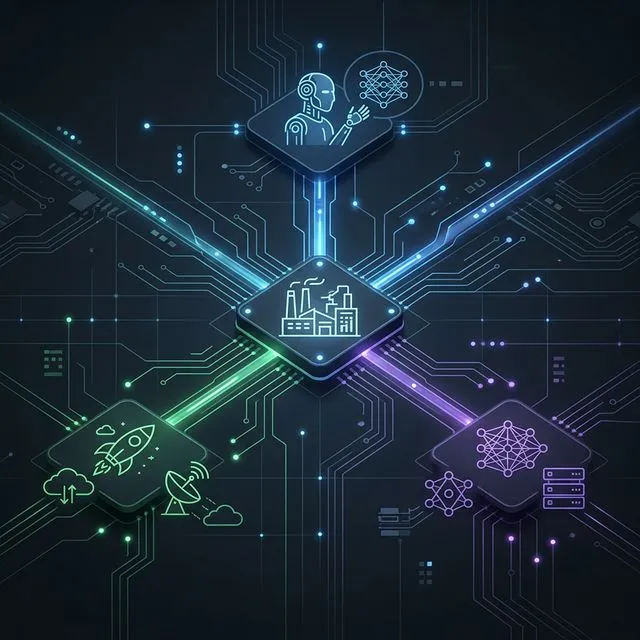
Based on Musk’s public remarks as summarized by Axios and Tom’s Hardware, Terafab is meant to be a full-stack chip operation:
- chip design
- memory
- packaging
- testing
- deployment into Tesla, xAI, and SpaceX systems
That kind of vertical integration is rare in advanced semiconductors because the economics and execution are brutal. Most companies specialize in only one or two layers of the stack. Even large AI firms still depend heavily on external foundries, packaging providers, and memory suppliers.
Musk’s pitch is that this dependence is becoming the bottleneck.
In other words: if AI demand keeps rising fast enough, buying chips from other people may stop being enough.
Why the 1-terawatt target matters
The 1 terawatt figure is the part that makes the story impossible to ignore.
Axios described it as a record-setting chip-building plan. Tom’s Hardware reported Musk framing the target as roughly 50 times current global annual AI compute production capacity. That exact comparison comes from Musk’s own presentation and should be treated as an ambition, not an independently verified industry baseline.
Still, the meaning is clear even if the estimate moves around:
Musk is talking about compute at a scale far beyond today’s normal fab expansion language.
That matters because it reflects the real mood of the market. The AI infrastructure race is no longer about adding “more GPUs.” It is about whether future winners will control enough power, chips, cooling, packaging, and deployment capacity to support orders-of-magnitude bigger systems.
This is the same broader infrastructure logic we covered in Why MCP Is Becoming the Default Standard for AI Tools in 2026, just at a lower level of the stack. Standards matter at the software layer. Ownership matters at the hardware layer.
The Austin angle is not incidental
One reason the plan looks more serious than a random Musk thought experiment is that Austin already gives him a cluster of assets:
- Tesla manufacturing
- proximity to Samsung’s Taylor, Texas semiconductor investment
- SpaceX and xAI operational overlap
- an existing Texas-friendly industrial expansion environment
According to Axios, the first advanced-technology fab would start in Austin. Tom’s Hardware likewise reported that the initial Terafab site would be built on Tesla’s campus in eastern Travis County.
That does not prove execution.
But it does mean the plan is being framed as a real industrial project with a place, not just a concept slide.
Two chip tracks show what Musk actually cares about
The most interesting detail in the reporting is that Terafab is not being pitched as one generic “AI chip.”
Instead, Musk reportedly described two chip lines:
- chips for Tesla vehicles and Optimus robots
- chips for space-based AI compute, powered by solar energy and launched by Starship
The first category is easier to understand. Tesla has been moving steadily toward custom silicon for autonomy, robotics, and training infrastructure for years.
The second category is where the story turns from aggressive to borderline science fiction.
Musk reportedly argued that space-based compute could become cheaper within two to three years. That claim depends on a stack of assumptions all working together:
- cheap enough launch economics
- reliable solar-powered orbital infrastructure
- workable cooling and maintenance assumptions
- enough demand for off-Earth compute deployment
That is not impossible in the abstract. It is just far from proven.
So the practical takeaway is not “space data centers are imminent.” It is that Musk is trying to think about compute supply as a planetary-scale constraint, not just a procurement problem.
Why vertical integration is the real story
The strongest part of the Terafab idea is not the rhetoric about galactic civilization.
It is the attempt to compress chip dependency into one ecosystem.
If Tesla, SpaceX, and xAI can meaningfully control design, packaging, testing, and final deployment, they could gain advantages in:
- time to production
- supply assurance
- chip specialization
- packaging optimization
- deployment speed
- bargaining power with outside suppliers
That does not mean they can replace TSMC or Samsung tomorrow. In fact, Tom’s Hardware noted that Musk said his companies would still keep buying from major suppliers including TSMC, Samsung, and Micron.
That point matters. Terafab is best understood as a bid to reduce strategic dependence, not fully eliminate it overnight.
This is also a signal about where AI competition is going
The AI market spent the last two years obsessing over models, benchmarks, and app layers.
Those still matter.
But Terafab is a reminder that the next competitive frontier is increasingly about infrastructure ownership:
- who controls chip supply
- who controls energy
- who controls packaging and deployment
- who can bring custom compute online fastest
That makes this story bigger than Musk.
Even if Terafab never reaches its most extreme targets, the logic behind it will keep spreading. The companies that believe AI demand will keep compounding are going to look for more control over the hardware stack.
This also connects to AI Coding Agents Need Guardrails, Not More Autonomy in a less obvious way. As AI systems become more operationally central, the infrastructure underneath them becomes more strategic. Compute is no longer just cost. It is governance, leverage, and execution capacity.
Final verdict
Terafab is still more declared ambition than proven manufacturing reality.
That distinction matters.
Right now, the most credible reading is this:
Musk is trying to build a vertically integrated compute supply chain across Tesla, SpaceX, and xAI because he believes future AI demand will overwhelm today’s chip and power model.
The 1-terawatt target may be aspirational. The space-compute timeline may be optimistic. The industrial challenge is enormous.
But the direction is real.
The AI race is getting less abstract.
It is becoming a fight over fabs, packaging, power, and who can bring extreme amounts of compute online before everyone else.
Sources