The splashiest version of this story is obvious: Mark Zuckerberg is building his own AI CEO while Meta prepares mass layoffs.
The more accurate version is slightly less cinematic, but much more interesting.
As of Monday, March 23, 2026, reporting summarized by Omni from The Wall Street Journal says Zuckerberg is developing a personal AI agent to help him be a better chief executive, mainly by surfacing information and handling communication faster. Separately, Reuters-reported layoff plans, summarized by outlets like TechRadar last week, suggest Meta could cut as much as 20% of its workforce, or roughly 16,000 employees, as AI spending rises and the company pushes harder on efficiency.
Those are two different stories.
Together, though, they point to the same thing: Meta is trying to turn AI from a product line into an operating model.
First, this is probably not literally an “AI CEO”
According to Omni’s March 23 summary of the WSJ report, Zuckerberg’s project is an AI agent to help him be a better boss by giving him faster access to information and helping manage communication. That sounds less like “replace the CEO” and more like an AI chief-of-staff, executive copilot, or internal management layer.
That distinction matters because it changes the practical question.
This is not really about whether an LLM is becoming the legal head of Meta. It is about whether top executives now believe internal AI systems can absorb work that used to flow through layers of managers, staff functions, and coordination overhead.
That is a much more serious story than the clickbait version.
The layoffs story gives the AI-agent story teeth
If the AI-assistant report existed on its own, it would still be interesting, but it would be easy to dismiss as executive experimentation.
The layoffs context makes it something else.
TechRadar’s March 2026 summary of Reuters reporting says Meta is preparing for possible major layoffs as AI costs increase, with some reports pointing to up to 20% of headcount being at risk. TechRadar also quotes a Meta spokesperson calling that reporting “speculative” and describing it as a report about theoretical approaches, which is an important caveat.
So, to be precise:
- the personal AI agent appears to be real enough to be reported by WSJ
- the large layoff scenario appears to be reported planning, not confirmed execution
- Meta itself has not publicly confirmed a 20% cut
Still, the direction of travel is obvious.
Meta has already been telling investors and the public that 2026 will be the year AI changes how the company works internally.
Meta has been signaling this for months
This did not come out of nowhere.
On January 28, 2026, Meta published 2026: AI Drives Performance, where it said 2026 would be the year AI would “transform how we work.” In the company’s Q4 2025 earnings call transcript, Meta said:
- output per engineer was up 30% since the start of 2025
- power users of AI coding tools increased output 80% year over year
- more projects that used to require big teams could now be done by a single highly capable person
Axios summarized the same message on January 29, 2026: Zuckerberg sees 2026 as the year AI starts to dramatically change how Meta employees work, especially as the company flattens teams and pushes “AI-native tooling.”
That is the backdrop for this week’s reporting.
The reported personal agent is not a weird side experiment. It fits Meta’s broader thesis that AI should compress coordination, increase individual output, and justify enormous capital spending.
What Meta is actually trying to do
The cleanest way to read this is that Meta wants AI at three layers at once.
1. Customer-facing AI
Meta is still trying to make AI visible across Facebook, Instagram, WhatsApp, and its business tools. The company’s January post and earnings materials make that very clear.
2. Revenue-producing AI
Meta keeps emphasizing ad systems, business assistants, and business messaging. This is the “AI pays for itself” layer.
3. Internal operating AI
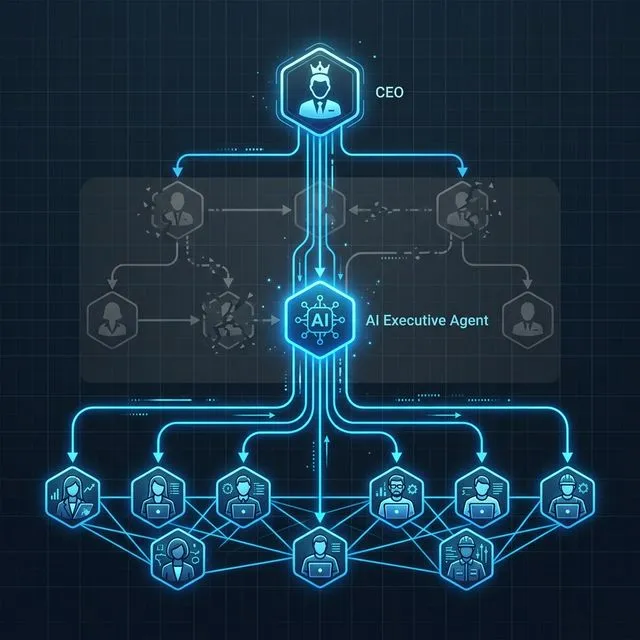 This is the part that matters most here.
If Meta believes AI tools can make individual employees and executives far more productive, then the company has an incentive to:
- flatten management layers
- shrink coordination overhead
- raise output expectations
- concentrate work in smaller, more AI-augmented teams
That is where the reported personal AI agent and the layoff conversation connect.
Why this matters beyond Meta
Meta is big enough that its internal operating choices function as a signal to the rest of tech.
If Zuckerberg is personally using an AI agent to run the company more efficiently, that sends a strong message to every other executive team: AI is no longer just for chatbots, coding copilots, or ad targeting. It is becoming part of executive decision infrastructure.
And if Meta also uses the same efficiency logic to justify workforce compression, other companies will absolutely watch the experiment.
That is what makes this story worth taking seriously even before every rumored cut is confirmed.
The real question is not “can AI be CEO?”
That question is mostly clickbait.
The more useful question is this:
How much managerial and coordination work inside a large company can be compressed by AI before the organization starts to change shape?
That is the real frontier here.
For years, AI adoption inside big companies mostly meant:
- support bots
- code assistants
- content generation tools
- analytics copilots
What Meta appears to be testing is something deeper: AI as a layer that helps run the company itself.
Not by replacing every human executive, but by reducing the number of humans needed to move information, summarize decisions, and coordinate action.
That is much more plausible, and much more disruptive.
The risk is obvious too
There is a reason this story makes people uneasy.
If management starts believing AI can replace substantial parts of internal communication and planning, two things happen fast:
- workforce reductions start looking strategically rational
- bad executive assumptions can scale faster too
A personal AI agent for a CEO is not automatically wise. It can still reflect biased inputs, incomplete reporting chains, or over-optimized internal metrics.
This is the same broad problem we covered in AI Coding Agents Need Guardrails, Not More Autonomy: the moment AI moves from generating text to shaping action, the quality of oversight matters a lot more.
And it also connects to AI Agents Are Everywhere, but Which Ones Are Genuinely Useful?. A useful agent is not the one with the flashiest demo. It is the one that reduces real work without quietly increasing a different kind of risk.
Meta is now testing that principle at organizational scale.
Final verdict
The simplified version of this story says Zuckerberg wants an AI CEO.
The more grounded version is better:
Meta appears to be building an internal AI operating layer, starting at the top.
That does not mean the company has solved executive automation. It does mean Zuckerberg seems to believe AI can now compress enough internal work to change how the company is run.
And if the layoff reports are even directionally right, the market implication is blunt:
Meta is not just building AI products.
It is trying to become an AI-managed company.
Sources