The most important AI coding trend right now is not just a better model.
It is that the biggest developer platform in the world is turning itself into a multi-agent workflow layer.
That shift became much harder to ignore across two GitHub releases. On February 4, 2026, GitHub announced that Claude and Codex were available in public preview on GitHub for Copilot Pro+ and Enterprise customers. On March 6, 2026, GitHub followed with a bigger workflow update inside VS Code: hooks, agent plugins, MCP servers, browser tools, shared memory, plan memory, and a built-in Explore subagent.
Those are not random feature bullets.
Together, they point to a more important product direction: GitHub does not just want to host your code and offer autocomplete. It wants to become the place where multiple agents coordinate work across issues, pull requests, IDE sessions, and reviews.
This is bigger than “Copilot added more models”
The February 4 release matters because it changed the agent surface area inside GitHub itself.
According to GitHub’s official changelog, Claude and Codex became available as coding agents in public preview for Copilot Pro+ and Copilot Enterprise customers. GitHub says you can start agent sessions and assign work to these agents from GitHub.com, GitHub Mobile, and VS Code, including directly from issues, pull requests, repository Agents tabs, and the VS Code session view.
That is an important change in product shape.
This is not just “choose your favorite model in a dropdown.” GitHub is turning model selection into task routing. The platform now treats agents as workers that can be assigned, monitored, reviewed, and redirected across the software lifecycle.
That fits a broader pattern we already covered in AI Agents Are Everywhere, but Which Ones Are Genuinely Useful?: the useful agent era starts when agents move from demos into bounded, real workflows.
The March release is where the architecture becomes obvious
If the February release expanded who could work, the March release showed how GitHub wants that work to happen.
In GitHub’s March 6, 2026 changelog for Copilot in VS Code v1.110, the company says the release makes agents practical for longer-running and more complex tasks. The details matter:
- hooks can run code at key agent lifecycle events to enforce policy, auto-lint, or block commands
- agent plugins can bundle skills, tools, hooks, and MCP servers
- agentic browser tools can navigate, click, screenshot, and verify changes
- agent memory is shared across the coding agent, Copilot CLI, and code review
- plan memory persists across turns and compaction
- the built-in Explore subagent handles fast, parallelized codebase research
That is not a chatbot feature set.
That is workflow infrastructure.
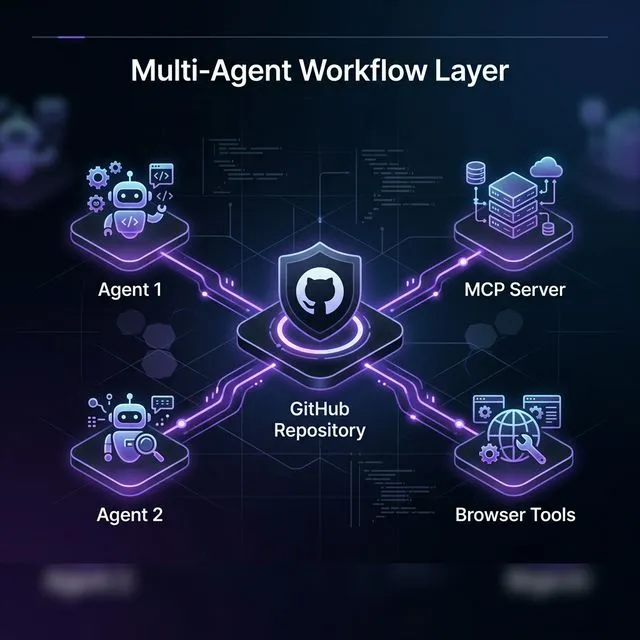
GitHub is effectively assembling the building blocks of a real multi-agent system:
- a control layer for assigning tasks
- execution environments across cloud, local, and background sessions
- persistent memory across tools
- policy hooks and bounded automation
- extension points through plugins and MCP servers
- delegated research through subagents
If you read the product direction this way, GitHub starts to look less like “Copilot plus some extras” and more like an agent orchestration environment for developer work.
Why this matters for real developer workflows
The most practical implication is simple: the center of gravity is moving from single-prompt help to coordinated task flow.
That changes what teams should optimize for.
Before, the main question was usually:
Which coding model writes better code?
Now the better question is:
Which environment can route, constrain, remember, and verify work better over time?
That distinction matters because most real software work is not one-shot generation. It is:
- exploring a codebase
- finding the right files
- planning a safe change
- executing it with guardrails
- checking outputs
- responding to review
- preserving context across sessions
GitHub’s recent releases target that exact loop.
This also connects directly to AI Coding Agents Need Guardrails, Not More Autonomy. Hooks, sandbox-aware approval flows, and explicit task routing matter because more capable agents without control layers just create faster ways to make expensive mistakes.
MCP is quietly part of this story too
One of the strongest signals in the March release is the mention of MCP servers inside agent plugins.
That matters because MCP is increasingly becoming the standard way agents connect to tools, docs, and external systems. If GitHub is packaging MCP into agent plugins, it is doing more than adding integrations. It is aligning its coding workflow layer with the same tool-connection model spreading across the rest of the AI stack.
That is exactly the pattern we described in Why MCP Is Becoming the Default Standard for AI Tools in 2026. The significance is not just interoperability. It is that agents become more useful when tool access is structured, composable, and portable.
GitHub adopting that shape makes the trend harder to dismiss as niche.
What this means for teams right now
You do not need to treat every new agent feature as production-ready on day one.
But you should update your mental model.
GitHub is no longer just competing on code completion or chat quality. It is competing on whether it can become the default operating layer for AI-assisted software work.
For teams, that means a few practical things:
- model choice matters less than workflow design
- persistent context is becoming a product feature, not a user hack
- policy enforcement is moving closer to the agent runtime
- delegated research and browser-based verification are becoming normal
- review and issue workflows are turning into agent entry points, not just human coordination surfaces
That last point is especially important. When issues, pull requests, and code review all become places where agents can start, continue, and validate work, GitHub stops being just where code lives.
It becomes where AI work is managed.
The real competitive threat is not another chatbot
The obvious competitors are tools like Claude Code, Codex, Cursor, Cline, Aider, and the agent stacks forming around them.
But GitHub’s advantage is different.
It already owns:
- repository context
- issues and pull requests
- review workflows
- enterprise policy controls
- developer identity and permissions
- a massive installed base
If GitHub can combine that with credible multi-agent orchestration, it does not need to be the most beloved chat UI. It just needs to be the easiest place for teams to run AI-assisted work inside the systems they already use.
That is a powerful position.
Final verdict
One of the clearest AI tool trends on March 24, 2026 is that developer platforms are becoming agent operating environments.
GitHub is the strongest current example.
The February release brought multiple coding agents directly into GitHub workflows. The March release added the deeper mechanics that make agents more persistent, extensible, and governable over longer tasks.
That is the real story.
GitHub is not just adding more AI.
It is trying to become the default control plane for multi-agent software work.
Sources