Why this matters now
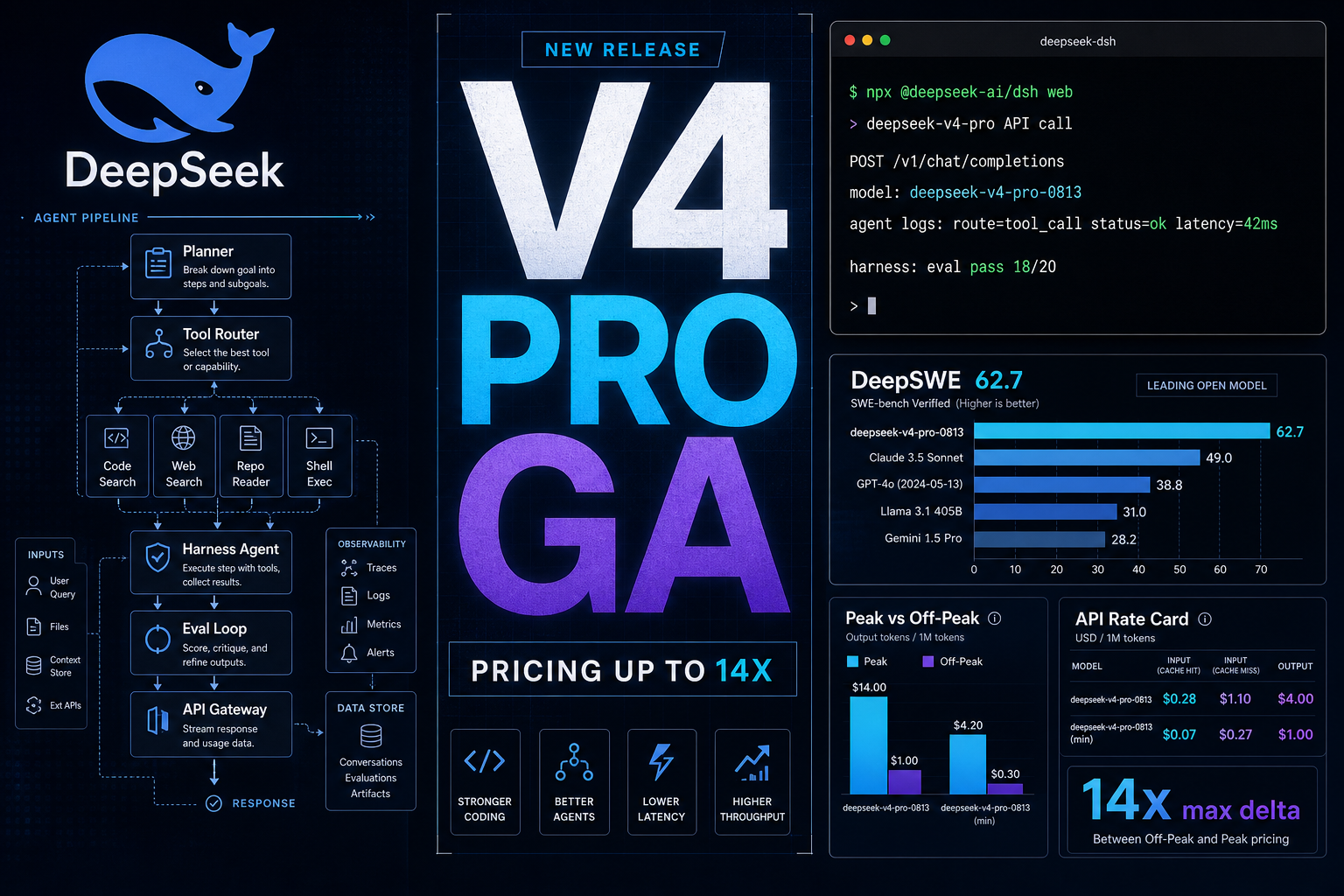
On August 13, 2026, DeepSeek shipped the general availability release of its flagship open-weight model, DeepSeek-V4-Pro-0813, and on the same day open-sourced DeepSeek Harness, its agent framework. Two days later the company restructured API pricing entirely: from 16:00 UTC on August 16 (today), V4 models move to peak/off-peak billing, with top-tier rates up to 14 times what V4 Flash cost last week. The AI model price war just got its first serious counter-move from the discount side of the market.
Three things matter for builders:
- V4 Pro went from a lukewarm preview to a genuinely competitive agent model — DeepSWE jumped from 12.8 to 62.7.
- Your per-token cost changed shape: off-peak rates are half of peak, and peak output for V4 Pro is now $3.96 per 1M tokens.
- DeepSeek Harness (
dsh) is an MIT-licensed, plugin-everything agent harness that hit ~112K GitHub stars in its first days — the company is clearly positioning for the agent developer market, not just API tokens.
What changed
- V4-Pro-0813 is GA, superseding V4-Pro (Preview). Same API names (
deepseek-v4-pro), new weights, MIT license, 1M context, 384K max output, and a newreasoning_effortparameter withlow/high/maxlevels. - DSpark speculative decoding ships with the release — a self-speculative draft module that speeds up generation without a separate draft model. One flag to enable in vLLM (
--speculative-config '{"method":"dspark",...}') or SGLang (--speculative-algorithm DSPARK). - DeepSeek Harness went open source (MIT, developer preview) under
deepseek-ai/deepseek-harness. It runs withnpx @deepseek-ai/dsh web, serves a web UI athttp://127.0.0.1:3080, and uses an architecture where “everything is a plugin,” built on the Cordis framework. - Pricing is now time-based. Peak hours are 01:00–04:00 and 06:00–10:00 UTC; everything else is off-peak at half price. The new rates replace the current flat pricing at 16:00 UTC on August 16.
- Concurrency limits tightened for the flagship: 500 concurrent requests for V4 Pro vs 2,500 for V4 Flash. If you fan out big agent workloads on the Pro tier, you will hit this.
DeepSeek-V4-Pro-0813 on Hugging Face — MIT-licensed weights, benchmark table, and DSpark deployment recipes.
The “up to 14x” headline that Reuters and others ran is real but needs context: it compares the new peak V4 Pro output price ($3.96) against last week’s V4 Flash output price ($0.28). Compared to old V4 Pro pricing ($0.87 output), peak is a 4.5x jump and off-peak is 2.3x. Still cheap by frontier standards — but the era of DeepSeek being the obvious default for price-sensitive workloads is over.
The model: where the GA release actually improved
The preview was easy to dismiss. The GA release is not the same model. DeepSeek’s own numbers (evaluated with the minimal Harness setup at max reasoning) show the biggest gains in exactly the places agents live:
| Benchmark | V4-Pro-0813 | V4-Flash-0731 | V4-Pro (Preview) | Kimi K3 | Opus 4.8 | Fable 5 (w/ fallback) |
|---|---|---|---|---|---|---|
| HLE (no tools / w/ tools) | 42.7 / 60.0 | 37.8 / 51.5 | 37.7 / 48.2 | 43.5 / 56.0 | 49.8 / 57.9 | 53.3 / 63.0 |
| Terminal Bench 2.1 | 87.9 | 82.7 | 72.1 | 88.3 | 85.0 | 88.0 |
| Cybergym | 83.3 | 76.7 | 52.7 | 80.0 | 78.3 | 83.1 |
| DeepSWE | 62.7 | 54.4 | 12.8 | 67.5 | 58.0 | 70.0 |
| Toolathlon-Verified | 74.1 | 70.3 | 55.9 | 76.5 | 76.2 | 77.9 |
| Agents’ Last Exam | 25.7 | 25.2 | 16.5 | 27.6 | 25.7 | — |
| AutomationBench (Public) | 31.8 | 25.1 | 12.8 | 30.8 | 27.2 | 29.1 |
| DSBench-FullStack † | 71.1 | 68.7 | 41.8 | 73.7 | 71.6 | 77.2 |
| DSBench-Hard † | 67.2 | 59.6 | 31.1 | 63.0 | 71.7 | 68.3 |
† Internal test sets. The rest are public benchmarks.
Read it straight: V4 Pro now sits in the same band as Kimi K3, Opus 4.8, and Fable 5 on agentic work — behind on most of them, ahead on a few (Cybergym, AutomationBench, DSBench-Hard), and 5–25 points better than the preview everywhere that matters. The preview’s DeepSWE score (12.8) was almost a joke; 62.7 is a real result. If you wrote V4 Pro off after the preview, the GA weights are worth a second look.
DeepSeek Harness: the other half of the release
Harness is not a model wrapper. It’s an agent runtime where the agent loop, tools, MCP servers, and UI are all plugins composed through Cordis. The pitch in the README is blunt: everything is a plugin, and the ecosystem is organized around the dsh-plugin GitHub topic.
The important bits:
- MIT licensed, npm-installable today:
npx @deepseek-ai/dsh web. - Developer preview: the README explicitly warns of compatibility-breaking changes. Do not bet production pipelines on plugin APIs yet.
- It’s framework-agnostic about models — you can point it at DeepSeek’s API or at Anthropic-format endpoints (DeepSeek now exposes
https://api.deepseek.com/anthropicfor drop-in Anthropic SDK compatibility). - The agent-benchmark numbers above were run with Harness in its minimal mode, which is a solid sign they’re eating their own dogfood.
Is it a “Claude Code rival” as VentureBeat framed it? In ambition, yes. In maturity, no — Claude Code has a two-year head start on UX and ecosystem. But the plugin architecture is genuinely different, and 112K GitHub stars in the first 72 hours says the developer appetite is real. It also gives DeepSeek a distribution channel that doesn’t depend on API pricing at all.
New pricing, in one table
Current rates (until 16:00 UTC Aug 16) per 1M tokens:
| Model | Input (cache miss) | Input (cache hit) | Output |
|---|---|---|---|
| deepseek-v4-flash | $0.14 | $0.0028 | $0.28 |
| deepseek-v4-pro | $0.435 | $0.003625 | $0.87 |
New rates (from 16:00 UTC Aug 16):
| Model | Off-peak in / out | Peak in / out | Off-peak cache hit | Peak cache hit |
|---|---|---|---|---|
| deepseek-v4-flash | $0.22 / $0.66 | $0.44 / $1.32 | $0.007 | $0.014 |
| deepseek-v4-pro | $0.66 / $1.98 | $1.32 / $3.96 | $0.022 | $0.044 |
What this does to real workloads:
- Off-peak V4 Pro output ($1.98) still undercuts Fable 5 and Grok 4.6 by a wide margin — Decrypt’s Aug 12 comparison put Fable 5 at roughly 4,500% the price of the V4 family for a ~5% quality edge. V4 Pro at $0.87/M output was about one-seventh of Grok 4.6’s price.
- Peak-hour V4 Flash ($1.32 output) now costs more than old V4 Pro ($0.87). If you schedule heavy batch jobs, that’s the whole game: move them off-peak and you pay half.
- Cache hits stay absurdly cheap ($0.044 peak) — prefix caching economics still dominate any workload with long system prompts.
The timing is not subtle: the price restructure lands the same week DeepSeek reportedly targets a ~$74B valuation ahead of a possible IPO, weeks after closing its first outside round ($7B at $50B). Raising prices into a capacity crunch (Reuters and InfoWorld both cite demand straining capacity) is standard supply-demand; raising them 4–14x and calling it “peak pricing” is a strategy.
Independent testing & community response
First-party benchmarks need a sanity check, and the coverage is genuinely mixed:
- Decrypt (Aug 12): “Claude Fable Is Only 5% Better at 4,500% the Price” — the price-performance framing is the strongest independent case for V4 Pro.
- South China Morning Post (Aug 13): the GA update “underwhelms — except in cybersecurity,” noting the Cybergym strength but calling the general gains incremental.
- The Information (Aug 13): “mixed reviews,” with early testers split on whether the agent improvements justify the price jump.
- Trendingtopics.eu: “rock-bottom cost per task, but trailing Kimi K3” — which matches the official table: Kimi K3 leads V4 Pro on DeepSWE, Toolathlon, and DSBench-FullStack.
- Tech Times: “benchmark claims await independent proof” — fair. The DeepSWE 12.8 → 62.7 jump is exactly the kind of number that needs a third-party run to believe.
- 36Kr’s hands-on test (Aug 13): “apart from its multimodal capabilities, it meets all my expectations” — about as positive as Chinese tech press gets.
The pattern: nobody disputes the price-performance ratio; several independent observers dispute whether V4 Pro is actually frontier-tier on agentic coding, where Kimi K3 still holds the open-weight crown. Treat the DSBench numbers as provisional until SWE-bench-style third-party runs appear.
| Claim | Source type | Verdict |
|---|---|---|
| V4 Pro GA beats preview massively on agent tasks | First-party (HF model card) | Plausible, needs independent confirmation |
| Fable 5 only ~5% better at ~45x the price | Independent (Decrypt) | Consistent with official table + pricing |
| Trailing Kimi K3 on agent benchmarks | Independent (trendingtopics.eu) | Matches official table |
| Cybersecurity gains are the standout | Independent (SCMP) | Matches Cybergym 83.3 |
| Mixed general impression | Independent (The Information) | Conflicts with Decrypt’s framing — read both |
Decision framework
Use V4 Pro (off-peak) when: you need frontier-adjacent agent quality, your workload is schedulable outside 01:00–04:00 and 06:00–10:00 UTC, and you can tolerate 500 concurrent requests. The $1.98/M output off-peak price has no serious rival at that quality band.
Use V4 Flash when: you’re building high-volume, latency-tolerant pipelines, or you want the 2,500 concurrency headroom. At off-peak $0.66 output it’s still one of the cheapest capable models alive, and the 0731 update closed most of the gap to Pro on tool use.
Use Kimi K3 instead when: DeepSWE-style agentic coding is the whole job. It leads V4 Pro on every serious coding-agent benchmark at $3/M input, and the weights are out (see our Kimi K3 writeup).
Use something else when: you need multimodal (V4 family has none), you can’t schedule around peak hours, or your agent farm needs more than 500 parallel requests — in which case route across providers and let V4 Pro handle only the off-peak overflow.
The honest takeaway: V4 Pro 0813 is the best open-weight agent model DeepSeek has shipped, and the price increase is real but survivable if you treat peak hours as a tax. The larger signal is strategic: DeepSeek is done being the cheapest option by default and is betting the open-source Harness ecosystem keeps developer mindshare while API revenue catches up. For cost comparison context, our July agent model cost analysis needs a revision — the floor just moved up.
Implementation notes
- Switch models by name only:
deepseek-v4-pronow serves 0813. Your OpenAI-compatible client code doesn’t change; just update the model string if you were pinning a preview snapshot. - Anthropic-format endpoint (
https://api.deepseek.com/anthropic) means Claude Code-style tools can point at DeepSeek without an adapter. Useful for testing Harness vs Claude Code on the same task. - Set
reasoning_effortexplicitly — the API defaults to thinking mode;lowhalves latency for simple tool calls,maxis what the benchmark numbers assume. - Self-host with DSpark:
vllm serve deepseek-ai/DeepSeek-V4-Pro-0813 --speculative-config '{"method":"dspark","num_speculative_tokens":7,"draft_sample_method":"greedy"}'on a 4×GB300 node. The weights are MIT; the hardware bill is not. - Cache strategy matters more now: with peak cache-hit at $0.044, a stable system prompt still wins, but the gap between hit and miss narrowed — re-evaluate whether your prefix is worth the context-window cost.
- Watch the concurrency cliff: 500 requests for Pro. If you’re migrating from Flash, rate-limit errors will surface first, not cost errors.
Related reading
- The AI Model Price War, July 2026 — the pricing dynamics that made DeepSeek’s hike inevitable.
- Kimi K3: Moonshot’s 2.8T Open-Weight Model — the open-weight model V4 Pro is still chasing on agent benchmarks.
- Agent Model Cost Comparison, July 2026 — pre-hike cost-per-task baseline; refresh your assumptions.
- Multi-Provider AI Gateways: Fallback Routing — how to absorb peak-hour price spikes without switching vendors.
Sources
- DeepSeek API Docs — Models & Pricing — current and peak/off-peak rate tables, effective Aug 16, 2026
- DeepSeek-V4-Pro-0813 model card, Hugging Face — benchmarks, MIT license, DSpark setup
- deepseek-ai/deepseek-harness, GitHub — MIT, developer preview, plugin architecture
- DeepSeek official release news — V4 Pro GA and Harness developer preview announcements
- Reuters — “DeepSeek launches V4 Pro at prices up to 14 times higher than V4 Flash” — Aug 14, 2026
- Decrypt — “China’s DeepSeek Upgrades V4 Pro: Claude Fable Is Only 5% Better at 4,500% the Price” — Aug 12, 2026
- VentureBeat — “DeepSeek Harness launches as open source rival to Claude Code, alongside V4-Pro on API with higher prices” — Aug 13, 2026
Also referenced: South China Morning Post (“flagship AI model update underwhelms – except in cybersecurity,” Aug 13, 2026), The Information (“DeepSeek’s Flagship V4-Pro Model Gets Mixed Reviews,” Aug 13, 2026), and Caixin Global (“DeepSeek Launches V4-Pro and Raises API Prices by as Much as 1,100%,” Aug 14, 2026) — all indexed in the Google News coverage for DeepSeek V4 Pro.
About the author
Charles Jasthyn De La Cueva is a full-stack developer and the founder of Open TechStack. He writes about AI engineering, developer tools, and practical model evaluation — grounded in real workflows, not press releases.