Why this matters now
AMD is buying Taalas, the Toronto startup that hardwires AI model weights directly into silicon — no GPUs, no HBM, no software stack in the hot path. The deal, announced after market close on August 6, is AMD’s opening move in the fight for the piece of the AI market Nvidia hasn’t locked down yet: fast, cheap inference for agents and code assistants.
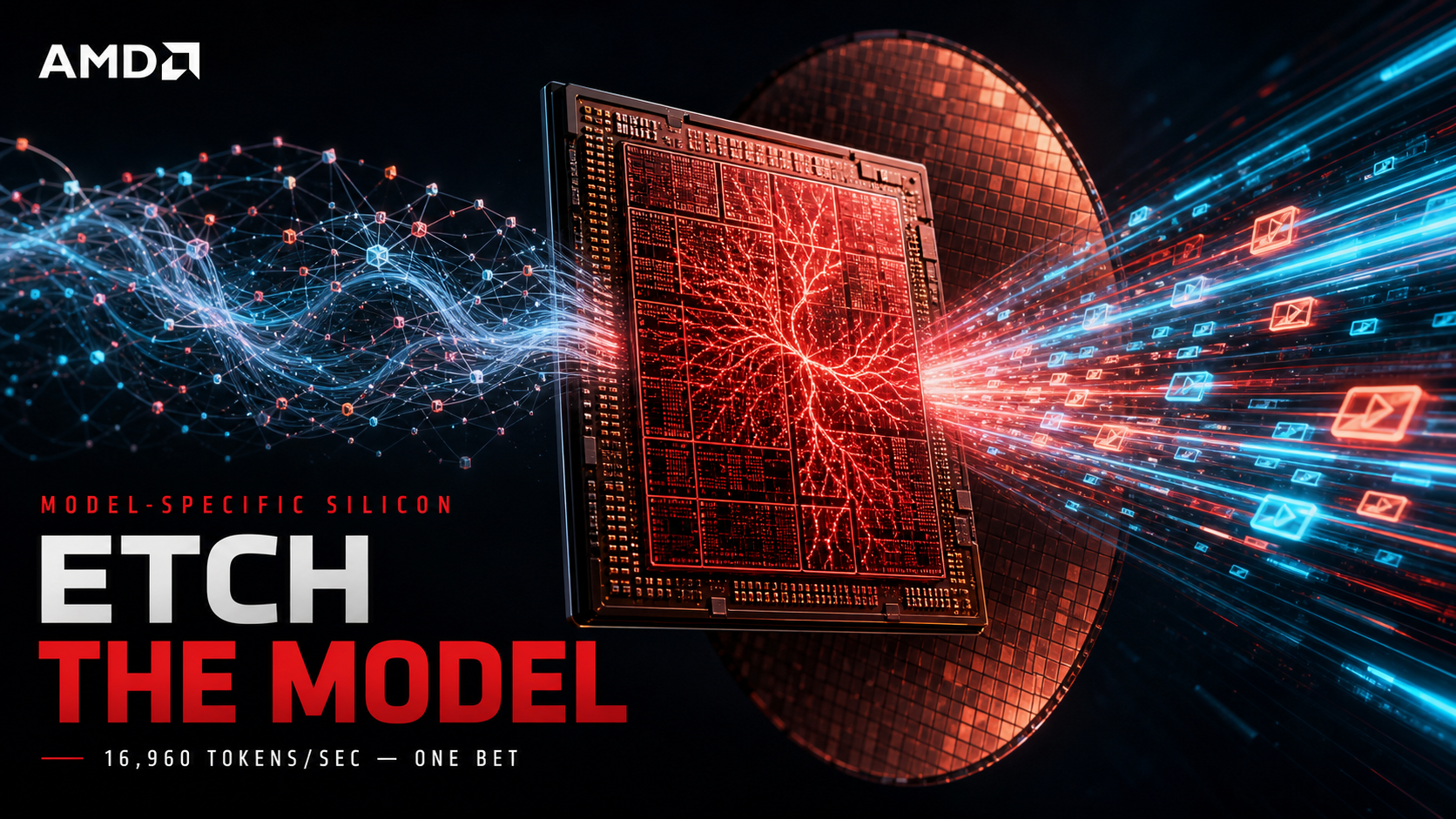
The headline number is hard to ignore. Taalas’s first test chip, the HC1, fabbed on TSMC’s 6nm process, served Meta’s Llama 3.1 8B at 16,960 tokens per second when it was revealed in February — 48x faster than Nvidia’s GPUs and 8.5x faster than Cerebras’ wafer-scale accelerators at the time. AMD hasn’t disclosed terms, but the Register reports this is a real acquisition, not an acquihire, and the deal is expected to close in Q4 2026 subject to regulatory approval.

For anyone running open-weight models, this is a preview of a future where your model isn’t just downloaded — it’s fabricated. That comes with a tradeoff builders need to understand before the hype cycle decides for them.
What AMD actually bought
Taalas’s approach is radically different from everything else in the inference hardware race. Groq uses dataflow architectures on SRAM, Cerebras builds wafer-scale engines, and Nvidia just keeps adding tensor cores — but Taalas etches the weights into the chip itself.
The company has been secretive about the details, but the Register’s reporting gives us the shape of the design: the processor has two main regions — a mask-ROM recall fabric where model weights are literally etched into silicon, and an SRAM recall fabric where KV caches and fine-tuning adapters live. There’s no HBM in the picture because there’s no need to shuttle weights from memory into compute. The weights are the silicon.
That’s why the throughput is so dramatic: a token generation step that normally involves moving gigabytes of weights across memory buses becomes a lookup in the physical circuit.
| Taalas HC1 (Feb 2026) | Nvidia GPU (2026-era) | Cerebras | |
|---|---|---|---|
| Llama 3.1 8B throughput | 16,960 tok/s | ~350 tok/s (relative) | ~2,000 tok/s (relative) |
| Weight storage | Etched in mask-ROM | HBM | On-wafer SRAM |
| Model flexibility | Re-spin required | Any model | Any model |
The second-gen chip, HC2, is due this summer and targets 20 billion parameters per chip. That’s where the economics get interesting: at 20B per chip, a trillion-parameter model needs just 50 accelerators using pipeline parallelism — which AMD happens to be well positioned to build, given its Helios rack-scale platform.
The Groq comparison and the race for premium inference
The framing is deliberate. Nvidia paid $20 billion to license Groq’s technology last December, a bet on “premium” inference services that AI agents and code assistants depend on. AMD’s Taalas play is the same bet with different chips: secure the hardware layer for the workloads where latency and cost-per-token actually decide who wins.
The Register’s reporting suggests AMD will pair Instinct-based Helios racks with Taalas accelerators in a disaggregated architecture — GPUs handle compute-heavy prompt processing, while token generation gets offloaded to the etched-model chips. Another plausible pattern: customers validate models on Instinct first, then graduate them to Taalas silicon once they’re proven.
AMD’s SVP of AI, Vamsi Boppana, framed it in full-stack terms:
“AMD is building a full-stack AI platform that gives customers the flexibility to deploy the right compute solutions for every AI workload. Taalas’ technology and world-class engineering team strengthen our AI portfolio by delivering differentiated inference performance and efficiency.”
Ljubisa Bajic, Taalas’s co-founder and CEO, put the philosophy more bluntly: build the hardware around the model.
The hard tradeoff for open-weights builders
Here’s the catch, and it’s a big one. Once a model is etched into silicon, you’re stuck with it. Any change bigger than a LoRA adapter means a re-spin of the chip — expensive, and measured in months, not days.
The Register notes that re-spins aren’t as catastrophic as they sound: only two layers of metal need to change to accommodate a new model, which is dramatically cheaper and faster than a full redesign. And Taalas has claimed that etching a model’s weights into silicon is 100x less expensive than training a frontier model — a number that makes sense when you consider the total cost of the data center required to train one.
But in a market where new open-weight models land nearly every month — Qwen 3.8-Max last week, DeepSeek V4-Flash before that, Meta’s Muse 2 before that — model-specific silicon only works when someone is confident enough in a model’s staying power to commit a fab run to it. That points to a specific pattern: MSICs will be deployed by model developers and inference providers who control the model roadmap, not by end users who rent capacity and swap models like API keys.
The open-weight AI infrastructure wave has been about composability — swap models, route around them, treat weights as interchangeable, the same philosophy behind multi-provider gateways. Taalas-style silicon is the opposite philosophy: pick a model, bet on it, etch it. Both will coexist, but they serve different builders.
What it means for inference costs and agent workloads
The most interesting downstream effect is on test-time scaling. One of the main ways developers cut hallucinations is letting models “think” longer — but that consumes dramatically more tokens, which makes it expensive and slow. If AMD’s Taalas play drives cost-per-token down by 10-20x, the calculus changes: reasoning models get to think longer for the same price, and agent loops that burn tokens on tool calls and retries become economically viable at much larger scale.
There’s also a subtle angle for the open-weights crowd: OpenAI, Anthropic, and Meta are all major Instinct customers. If a GPT or Claude ends up deployed on a Taalas-and-Instinct combination, the closed labs get the efficiency win — but so does anyone running Llama or Qwen on AMD hardware. Open weights are the most natural fit for model-specific silicon, because the weights are public and the model card is stable enough to commit to.
The deal is expected to close in the fourth quarter. Until then, the practical takeaway for builders is simple: watch how AMD positions Taalas capacity when it ships, and remember that the fastest inference on earth still runs one model at a time.
Sources: The Register, CNBC, AMD press release, Hacker News discussion.
Related reading
- Open-Weight AI’s Kubernetes Moment — Why portable weights matter to infrastructure builders.
- Qwen3.8-Max: Alibaba’s Open-Weight Frontier Launch — A recent model release that shows the speed of the weight cycle.
- Multi-Provider AI Gateways — The composable alternative to model-specific hardware.
Sources
- AMD — AMD acquires Taalas to advance compute solutions for the rapidly growing AI inference market
- The Register — AMD acquires AI chip startup Taalas to boost inference performance
- CNBC — AMD buys Taalas, the startup hardwiring AI models into silicon
- Hacker News — AMD acquires Taalas discussion — practitioner discussion and implementation context.
About the author
Charles Jasthyn De La Cueva is a full-stack developer and the founder of Open TechStack. He writes about AI engineering, developer tools, and practical model evaluation — grounded in real workflows, not press releases.